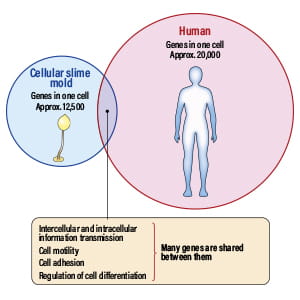
Life evolved from unicellular organisms to multicellular organisms. Cellular slime molds have a dramatic life cycle: upon entering a state of starvation, unicellular amoebae aggregate to form a multicellular body and produce spores in the space of just 24 hours. Although they have genes common to humans and other multicellular organisms, including genes involved in apoptosis and cell differentiation, the size of their genome is one-hundredth that of humans. Equipped with the attributes of both animals and plants, they have undergone a unique evolutionary path and are regarded worldwide as an important model organism for exploring the origins of the development of multicellularity. Their diverse secondary metabolites are expected to have applications in drug discovery.
