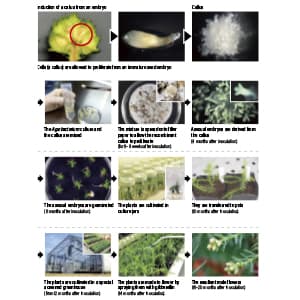
It was in the 1960s that hay fever caused by common ragweed (Ambrosia artemisiifolia) and Japanese cedar (Cryptomeria japonica) was first reported in Japan. Since then, the prevalence of pollen allergy has grown year by year to such an extent that it is now called the “national disease” of Japan. The most common form of the disease is Japanese cedar pollinosis, from which approximately 40% of the Japanese population suffers. However, as Japanese cedar —— also known by its Japanese name, sugi —— is a resource essential to Japan’s daily life and the conservation of its land, the Forestry Agency has been endeavoring to develop low-pollen varieties of the tree. Now, thanks to genome editing technology, improvements aimed at creating a variety that produces no pollen at all are progressing. There are high hopes that humans and sugi trees might be able to coexist.
