
The symbiotic relationship between eukaryotes and mitochondria began 2.1 billion years ago, after a primitive cell engulfed a bacterium. Since then, mitochondria have evolved into essential cellular organelles, which play a crucial role in energy production, thereby supporting vital biological activities, and have a profound influence on human health. They are also known to be closely connected to motor function impairments and neurodegenerative disorders, and increasing attention has been paid to their relationship with aging and Alzheimer’s disease. In recent years, various studies have been focusing on mitochondria, which have their own DNA, as a means of investigating the fundamental principles of life.
Special Feature 1 – The Impact of Mitochondria The bacterial origin of cellular organelles essential for life
composition by Rie Iizuka
Toshiya Endo
Professor, Faculty of Life Sciences, Kyoto Sangyo University
Successfully completed a doctoral program at the University of Tokyo’s Graduate School of Science in 1982 and was awarded a Ph.D. in science. After holding the posts of research assistant and assistant professor at the College of Technology, Gunma University, and assistant professor at Gunma University’s Faculty of Engineering, he took up the post of assistant professor at Nagoya University’s Faculty of Science, and was subsequently appointed professor there in 1991. He later served as professor at Kyoto Sangyo University’s Faculty of Life Sciences, before being appointed to his current position in 2019. He heads the Institute for Protein Dynamics at Kyoto Sangyo University, and is a professor emeritus of Nagoya University. His research focuses on mitochondrial biogenesis, with a particular emphasis on the molecular mechanisms of protein and lipid transport into and within mitochondria.
Mitochondria are organelles found in eukaryotic cells. Eukaryotic cells are defined by the presence of a nucleus, and organisms that have this type of cellular structure are called eukaryotes. All animals, including humans, belong to this group of organisms, as do plants, and fungi such as yeasts and molds. In humans, each cell contains several hundred to thousands of mitochondria. Cells that do not have a nucleus, such as bacteria and cyanobacteria, are called prokaryotic cells; these cells contain no organelles.
The interesting thing about mitochondria is that they are organelles originally formed through the integration of another organism.
Mitochondria were originally anaerobic bacteria
Earth in ancient times had no oxygen and was inhabited by bacteria that needed no oxygen, but one group of them—cyanobacteria—began to perform photosynthesis, releasing oxygen into the atmosphere as a waste product. Aerobic bacteria that used this oxygen to produce large amounts of energy then emerged. Another bacterium that was in the process of developing nuclei engulfed an aerobic bacterium, but rather than being digested, the swallowed-up bacterium established a stable symbiotic relationship with its host, without harming the host or being broken down by it.
The host bacterium that integrated the aerobic bacterium was originally anaerobic—that is to say, a bacterium that does not use oxygen. By integrating an aerobic bacterium, it gained a means of using oxygen to efficiently acquire large amounts of energy. This revolutionary event occurred 2.1 billion years ago.
The bacterium that engulfed the aerobic bacteria developed nuclei and became an eukaryotic cell, while the incorporated aerobic bacterium evolved into the mitochondrion. The mitochondrial ancestor is thought to have belonged to the class Alphaproteobacteria, but the identity of the host bacterium remains largely unknown.
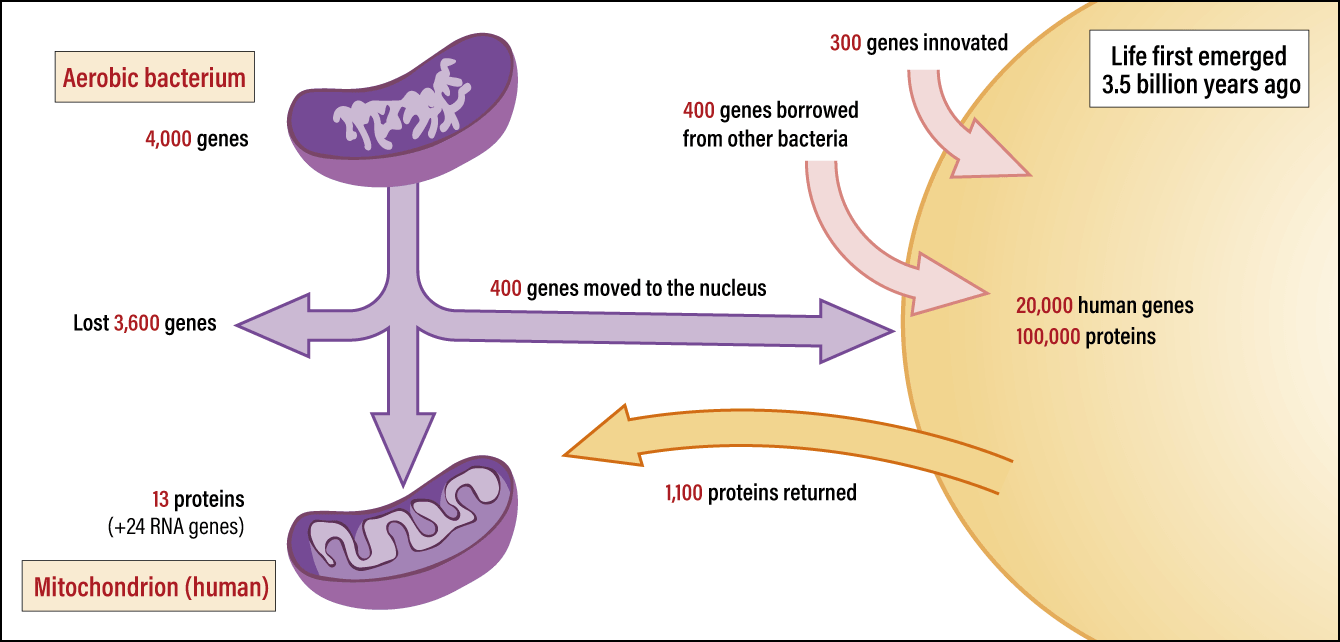
Mitochondria lost many genes over the course of the evolutionary process (Figure 1).
 Vafai SB, Mootha VK. Nature, 491: 374-384, 2012.
Figure 1. The process of mitochondrial symbiosisDuring the process of symbiosis, mitochondria discarded or transferred most of their genes to the host nucleus while retaining only those that could not be replaced, and established a system for importing synthesized proteins and lipids back into the organelle.
As mitochondria were originally free-living bacteria, they had thousands of genes before they became symbiotic with cells, and they synthesized all proteins required for their proliferation. However, after being incorporated into a host cell, many genes were transferred from the mitochondrial genome to the host nuclear genome, others were acquired from different bacteria, and some new genes were created for the symbiosis. Human mitochondria have more than 1,000 different proteins, but in the symbiotic process, the genes for most of these proteins are relocated to the host cell nucleus, establishing a sophisticated system in which these proteins are synthesized in the host cytosol and imported back to mitochondria.
Maternal inheritance of mitochondria
Today, genes that synthesize 13 different proteins are retained in human mitochondria. Why these genes were not completely transferred to the nucleus remains unclear, but it is possible that these proteins may not become functional without their co-translational assembly into protein complexes within mitochondria.
In biological systems, some structures are newly made from scratch, while others are copied from pre-existing templates; mitochondria are a good example of the latter. Even if there is a blueprint in the form of the nuclear DNA, which provides the instructions to produce proteins and RNA, new mitochondria cannot be formed without pre-existing mitochondria that have the machinery for their assembly. Just as all our cells today have been created through the replication and division of cells that have existed since the very beginning of life, mitochondria that evolved through symbiosis with eukaryotic cells have also been inherited. Consequently, mitochondrial DNA allows us to trace the process of evolutionary history in a way different from using nuclear DNA.
Mitochondria exhibit many intriguing and enigmatic features, and one of the most striking is the mitochondrial maternal inheritance. As stated above, human mitochondrial DNA synthesizes 13 proteins, all of which are inherited from the mother.
During fertilization, almost all paternally derived mitochondria from sperm are eliminated, and even if they enter the fertilized egg, paternal mitochondria are swiftly broken down by a mechanism such as autophagy. While the mitochondrial DNA in the egg is different from that in the sperm, it remains unclear how sperm-derived mitochondria are specifically marked for removal. From an evolutionary perspective, genetic diversity generally enhances adaptability and reduces the risk of disease. However, despite this potential advantage, mitochondria maintain a strict mechanism to preserve only maternal DNA, making maternal inheritance a profoundly interesting phenomenon.
Mitochondria have a wide range of functions, the best known of which is energy production. Human mitochondria use the nutrients and oxygen to produce an amount of adenosine triphosphate (ATP) every day that is roughly equivalent to an individual’s body weight. This is why mitochondria are called power plants of the cell. Due to this dramatic increase in energy production, around 20 times more energy than before, eukaryotes succeeded in their evolution into multicellular organisms.
Mitochondrial ATP production can be compared to hydroelectric power generation. Mitochondria are surrounded by two membranes, with the proton concentration difference between the outside and inside of the inner membrane, causing the ΔpH and electrical membrane potential across the membrane. Just as a dam uses the fall of water to generate electricity, mitochondria employ this proton concentration gradient to drive a flow of hydrogen ions through an enzyme that functions like a turbine. As hydrogen ions flow through it, ATP—which serves as the energy currency of the cell—is produced on the inner membrane.
Another crucial function of mitochondria is the synthesis of iron-sulfur clusters. These clusters are essential cofactors for enzymes of the electron transport chain and are also required for the citric acid cycle and DNA maintenance within mitochondria, as well as playing many other essential roles in biological activity, such as regulating gene expression outside mitochondria.
Because iron-sulfur clusters were already indispensable cofactors in ancestral bacteria, both the host cell and the mitochondrial ancestor originally possessed their own synthesis systems. However, after symbiosis was established, mitochondria became responsible for their production since there was no need for two separate systems for the same purpose. Aside from this, the host bacteria also ended up delegating portions of the metabolism of amino acids and lipids to mitochondria. Under conditions such as starvation, mitochondria are responsible for producing energy from lipids, for cellular survival.
The signal by the leakage of a small amount of DNA
Mitochondria have thus undergone a remarkable transformation over the last 2.1 billion years while exploring and establishing symbiosis with their hosts, eventually becoming indispensable to each other. While the production of ATP and iron-sulfur clusters was a major element contributing to dramatic evolutionary advances, mitochondria and their hosts have, in their symbiotic relationship, continued to innovate mutually beneficial functions across a variety of contexts.
For example, there is a phenomenon in which mitochondrial DNA escapes across the mitochondrial membranes into the cytosol. Since mitochondrial DNA is essential for producing proteins that are crucial to mitochondrial functions, its release from mitochondria is a serious event. However, precisely because it is serious, cells have come to use this as an emergency signal. An extreme example is the induction of apoptosis (programmed cell death) in cells. Not only DNA but also proteins are released from mitochondria to the cytosol, announcing that it is time to die.
Furthermore, recent studies have revealed that leakage of only small amounts of mitochondrial DNA to the cytosol is a signaling cue to activate an immune response during bacterial or viral infection. Once the immune response has been started, mitochondria could return to their normal state. This suggests that, during the course of symbiosis, a mechanism was invented whereby a noncanonical mitochondrial behavior causes coordinated responses at the cellular and organismal levels, which is a highly intriguing aspect of mitochondrial biology.
Mitochondria are often drawn in textbooks as bean-shaped organelles. However, in most cases, they do not exist as fragmented or isolated entities, but instead, they continuously fuse into thread-like networks and divide into pieces, moving dynamically in the cell (Figure 2). They also repair localized damages, or when damage is severe, mitochondria can be entirely degraded while the remaining population proliferates.
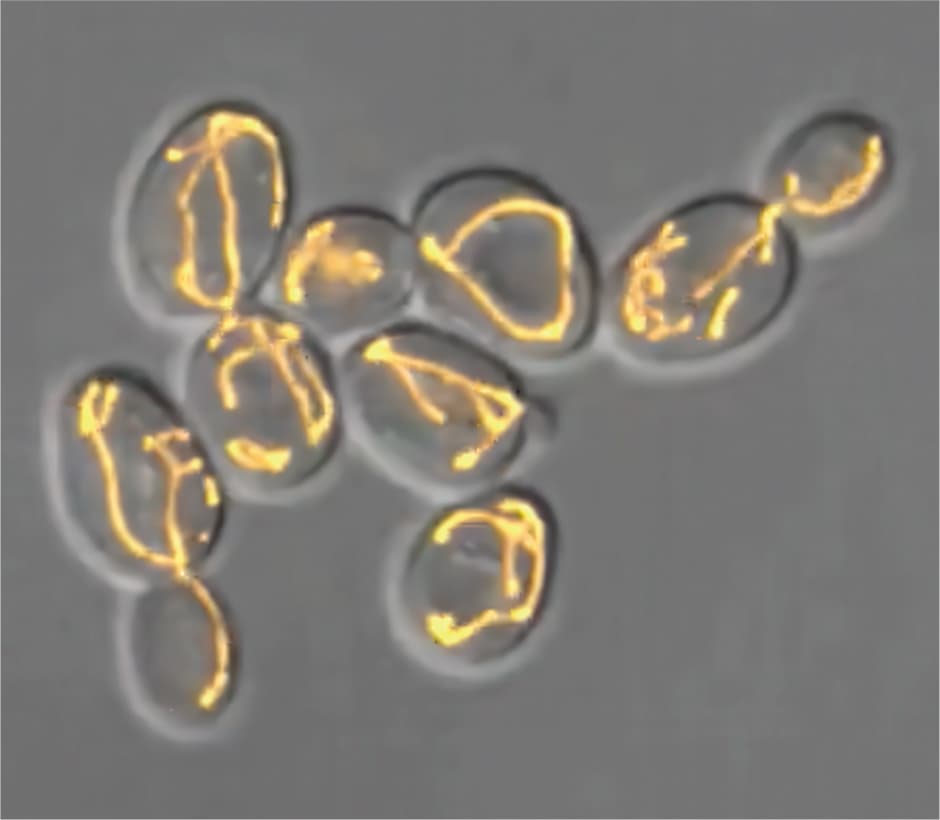
Figure 2. Mitochondria in yeast cellsThe yellow lines within the cells are mitochondria. The image also captured their propagation during cell division.
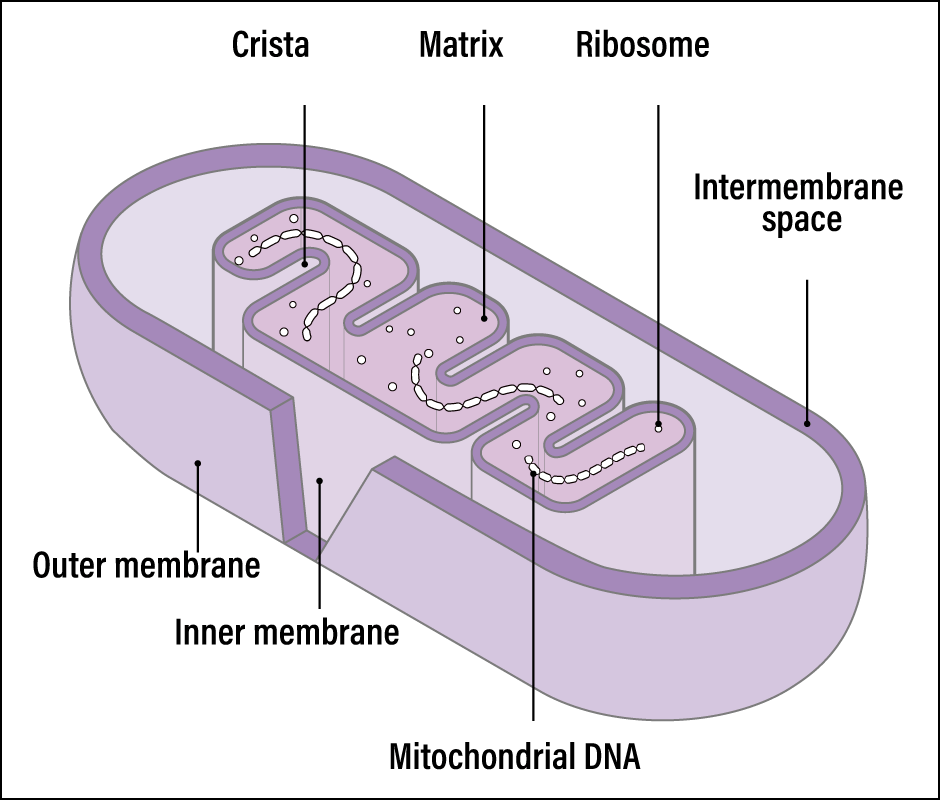
Surrounded by two membranes, mitochondria consist of four compartments: the outer and inner membranes, and the aqueous intermembrane space and luminal matrix (Figure 3). Each compartment contains specific sets of proteins that ensure biochemical reactions occur in the appropriate location. Most of these proteins are imported from the cytosol, while a handful of proteins are synthesized in the matrix, and are then correctly sorted to their destination compartments. Lipids of the outer and inner membranes are also imported from outside the organelle, redistributed between membranes, and converted into appropriate forms that support protein function. In my laboratory, we are studying these systems for transporting proteins and lipids into and within mitochondria.
 (Figure courtesy of ImageMart)
Figure 3. The internal structure of a mitochondrionA mitochondrion is enclosed by two membranes. It consists of four compartments: the outer and inner membranes, and the aqueous intermembrane space and matrix.
As mentioned earlier, mitochondria are organelles that replicate themselves. Pre-existing mitochondria grow and divide, thereby increasing their number. This means that understanding how materials are transported and processed is a key to elucidating how mitochondria build themselves and maintain their integrity, the mechanism of mitochondrial biogenesis and functional maintenance in cells, which in turn are crucial for maintaining cellular health, and ultimately, human health.
Relationship to aging and functional decline
As mitochondrial research has advanced, its relevance to a variety of diseases has become increasingly apparent. Mitochondrial diseases are known as disorders with impaired energy production, leading to motor dysfunction and organ damage. Beyond these disorders, neurodegenerative disorders, for example, have been implicated to be closely linked to mitochondrial quality control. Involvement of mitochondria in aging and Alzheimer’s disease has attracted widespread attention and is now the subject of extensive research.
Light fasting and aerobic exercise, such as walking, are considered effective for increasing the number of healthy mitochondria and their activation. Maintaining normal function of mitochondria requires their continuous replenishment, which in turn requires normal cellular functions, along with appropriate supply of proteins and lipids.
Within a single cell, hundreds to thousands of mitochondria coexist in diverse functional states. Some are highly active, while others may be dysfunctional. As the proportion of dysfunctional mitochondria increases, cellular and organismal health begins to decline. In other words, increasing the number of healthy mitochondria would be beneficial, but cells are also equipped with a regulatory system that monitors and controls their abundance, preventing excessive increases or decreases. Although the mechanism of controlling mitochondrial quantity is not yet fully understood, the processes underlying mitochondrial biogenesis—including protein and lipid transport, functionalization, and quality control—have become relatively well understood. Accordingly, if we could manipulate both the regulatory systems controlling mitochondrial abundance and the triggers of mitochondrial production, it might be possible to transiently increase the number of mitochondria.
In aging societies, increasing interest is focusing on how to extend our healthy life expectancy. As investigations into age-related functional decline frequently point back to mitochondrial function, mitochondrial research has expanded rapidly in recent years.
Another reason for the growing interest in mitochondrial research is the recognition of the profound extent to which our cells depend on mitochondria. Over the course of evolution, cells have continually repurposed mitochondrial functions for new roles—as if saying, “Let’s use them for this too, and for that as well.” As a result, our cells have achieved optimization and the best risk management by relying on the presence of mitochondria. Mitochondria continue to provide new research themes, both from the perspective of evolutionary biology as well as the studies of practical issues such as aging and diseases, which will bring us further discoveries across multiple fields.
(Figures courtesy of Toshiya Endo)