
Nutrition management is a key topic for athletes, as it is directly linked to their performance. For female athletes in particular, a common problem caused by the failure to achieve a dietary intake commensurate with their level of exercise is low energy availability, with consequent hypothalamic amenorrhea and osteoporosis, which are together referred to as the “female athlete triad.” Scientists say one factor behind this is the preference for lightness —— the belief that a lighter body will perform better. However, caution is required because, in fact, this commonly results in insufficient energy intake. Appropriate nutrition management is crucial.
Special Feature 1 – Sports and Nutrition Energy intake is a key challenge in managing athletes’ health
text by Toshiko Mogi

Yoshiko Ishii
Part-time specialist, Japan Institute of Sports Sciences
Special Lecturer, Kagawa Nutrition University
Registered dietitian, JSPO sports dietitian, and health fitness programmer. Originally from Kanagawa Prefecture. Graduated from Kagawa Nutrition University and completed the university's graduate program. As a high school student, she was a track and field athlete who competed in the Inter High School Athletic Meet, but was unable to achieve her target performance due to difficulties with weight management. This experience inspired her to specialize in sports nutrition. In recent years, she has been focusing her research on supporting female athletes from a nutritional perspective, as well as providing dietary guidance, conducting seminars, and giving lectures for athletes.
There are biological differences between men and women. But do such sex-based differences also exist with regard to the appropriate nutritional intake that helps athletes to build up their bodies? That question formed the starting point for this interview. Yoshiko Ishii, who is involved in nutritional science research relating to menstruation in female athletes, was kind enough to answer our questions.
“I’m not a researcher specializing in differences between the sexes,” she says. “At the Japan Institute of Sports Sciences, I provide many athletes with nutritional support as a registered dietitian and JSPO sports dietitian, while also conducting research into health problems relating to menstruation in female athletes from a nutritional perspective. I’d like to talk about the findings and observations I’ve gathered through my work. To answer your question, men have larger bodies, so they have a high basal metabolic rate (BMR). As such, they need more energy and nutrients —— these are well-known facts.”
While explaining this, Ishii showed me the Dietary Reference Intakes for Japanese. These are standards setting out the amounts of energy and nutrients that a healthy Japanese person should consume in their diet, and are prescribed by the Ministry of Health, Labour and Welfare (MHLW). They are revised every five years, and the version currently in use was just published in April 2025.
“Take a look at Tables 1 and 2,” she says. “Both the estimated energy requirement and the estimated energy requirement per kilogram of body weight per day are higher for men than for women. These differences stem from disparities between men and women in terms of muscle mass and BMR. There’s a difference in physique —— men have more muscle mass than women. And the greater the muscle mass, the higher the BMR, which means more energy is required.”
| Sex | Males | Females | ||||
| Physical activity level11 | Low | Medium | High | Low | Medium | High |
| 0-5 months | – | 550 | – | – | 500 | – |
| 6-8 months | – | 650 | – | – | 600 | – |
| 9-11 months | – | 700 | – | – | 650 | – |
| 1-2 years | – | 950 | – | – | 900 | – |
| 3-5 years | – | 1,300 | – | – | 1,250 | – |
| 6-7 years | 1,350 | 1,550 | 1,750 | 1,250 | 1,450 | 1,650 |
| 8-9 years | 1,600 | 1,850 | 2,100 | 1,500 | 1,700 | 1,900 |
| 10-11 years | 1,950 | 2,250 | 2,500 | 1,850 | 2,100 | 2,350 |
| 12-14 years | 2,300 | 2,600 | 2,900 | 2,150 | 2,400 | 2,700 |
| 15-17 years | 2,500 | 2,850 | 3,150 | 2,050 | 2,300 | 2,550 |
| 18-29 years | 2,250 | 2,600 | 3,000 | 1,700 | 1,950 | 2,250 |
| 30-49 years | 2,350 | 2,750 | 3,150 | 1,750 | 2,050 | 2,350 |
| 50-64 years | 2,250 | 2,650 | 3,000 | 1,700 | 1,950 | 2,250 |
| 65-74 years | 2,100 | 2,350 | 2,650 | 1,650 | 1,850 | 2,050 |
| 75+ years2 | 1,850 | 2,250 | – | 1,450 | 1,750 | – |
| Pregnant women (additional)3 | ||||||
| Early-stage | +50 | |||||
| Mid-stage | +250 | |||||
| Late-stage | +450 | |||||
| Lactating women (additional) | +350 | |||||
1
Physical activity levels are classified into three categories: low, medium, and high.
2
Medium indicates the physical activity level of people who can support themselves, and low indicates the physical activity level of people who do not usually go outside. Low is the physical activity level that can be adapted to people who can support themselves in a nursing home.
3
It is important to assess the physique of individual pregnant women, weight increases during pregnancy, and fetal growth.
Note 1:
When applying this table, ensure dietary intake, measurement of body weight, and BMI calculation are assessed. Excess energy or inadequate energy should be evaluated according to changes in body weight or BMI.
Note 2:
If a subject’s physical activity level is low, energy intake may have to be maintained at a low level to match their low energy consumption level. Such subjects need to increase the level of physical activity from the perspective of health maintenance and promotion.
Tables 1 and 2 have been compiled on the basis of MHLW, Dietary Reference Intakes for Japanese (2025), October 2024.
Table 1. Estimated energy requirement (kcal/day)
| Sex | Males | Females | ||||
| Physical activity level1 | Low | Medium | High | Low | Medium | High |
| 1-2 years | – | 82.4 | – | – | 80.6 | – |
| 3-5 years | – | 79.5 | – | – | 75.7 | – |
| 6-7 years | 59.8 | 68.7 | 77.5 | 56.6 | 64.9 | 73.3 |
| 8-9 years | 57.1 | 65.3 | 73.4 | 53.6 | 61.3 | 68.9 |
| 10-11 years | 54.2 | 61.7 | 69.2 | 50.5 | 57.4 | 64.4 |
| 12-14 years | 46.5 | 52.7 | 58.9 | 44.4 | 50.3 | 56.2 |
| 15-17 years | 41.9 | 47.3 | 52.7 | 39.2 | 44.3 | 49.3 |
| 18-29 years | 35.6 | 41.5 | 47.4 | 33.2 | 38.7 | 44.2 |
| 30-49 years | 33.8 | 39.4 | 45.0 | 32.9 | 38.3 | 43.8 |
| 50-64 years | 32.7 | 38.2 | 43.6 | 31.1 | 36.2 | 41.4 |
| 65-74 years | 32.4 | 36.7 | 41.0 | 31.1 | 35.2 | 39.3 |
| 75+ years2 | 30.1 | 36.6 | – | 29.0 | 35.2 | – |
1
Physical activity levels are classified into three categories: low, medium, and high.
2
Medium indicates the physical activity level of people who can support themselves, and low indicates the physical activity level of people who do not usually go outside. Low is the physical activity level that can be adapted to people who can support themselves in a nursing home.
Note:
Caution is required because, the estimated energy requirement may be higher for individuals or groups whose weight is below the reference weight, and lower for those above it.
Tables 1 and 2 have been compiled on the basis of MHLW, Dietary Reference Intakes for Japanese (2025), October 2024.
Table 2. Estimated energy requirement per kilogram of body weight (kcal/kg/day)Generally, physiological differences between men and women lead to differences in the energy required to maintain their bodies and lives. Using this as the basis, athletes consume a diet guided by their energy requirements, taking into account the amount they train and other individual circumstances.
More precise estimation of BMR
For athletes, nutritional support for their diets is essential to keep training day to day and achieve peak performance in competition. Appropriate nutritional support also helps to prevent and ameliorate the various disorders to which athletes are prone, including dehydration, anemia, and stress fractures. How is the amount of energy required by such athletes calculated?
“The amount of energy required by athletes differs according to such factors as their age, sex, physical status, sport, and training program,” Ishii explains. “In terms of the energy requirements of athletes in their growth period and people who engage in sport for fun, it makes sense to use the figures for high physical activity levels listed in the Dietary Reference Intakes for Japanese (Tables 1 and 2) as a guide. However, when it comes to professional and top athletes, we regularly measure not only their weight, but also their physical composition, and use their fat-free mass (FFM) to calculate their BMR.”
FFM is the figure obtained by deducting the amount of body fat from body weight, and indicates the total weight of tissue such as muscle, bones, and internal organs. As a result of their daily training, an athlete may have low body fat, even if their weight increases. Athletes’ physical composition may also vary according to their sport, even if they are the same weight, while an individual athlete’s physical composition may fluctuate between the sporting season and the off season. Considering these facts, BMR is estimated more precisely by measuring their physical composition.
It has also been reported that different calculation formulas are used for men and women when using FFM to estimate BMR.
“BMR calculated in this way is then used to calculate the athlete’s energy requirement, taking into account the circumstances of each individual, including their age, sex, sport, and training routine,” Ishii tells me.
In the case of females, for example, consideration based on sex means thinking about menstruation and establishing a diet that increases their target iron intake. Ishii also interviews athletes regularly to ask them about such matters as weight changes and the number and content of their meals.
“Weight is an indicator for adult athletes because if the figure doesn’t change, it’s likely that they’re consuming around the same amount of energy that they’re burning,” she says. “However, based on fluctuations in weight alone, it’s hard to tell whether they’re due to changes in muscle or changes in fat.”
Thus, physical composition needs to be measured to make more precise estimates. In addition, Ishii evaluates the content and nutritional balance of athletes’ meals to provide nutritional guidance, while making any necessary corrections based on the PDCA cycle (a technique for continuous improvement that involves four iterative steps; Plan, Do, Check, Action).
As athletes’ energy requirements calculated in this way vary according to their individual circumstances, it would be fair to say that personalized factors have greater influence than sex-based differences.
“Based on my research and the cases I’ve worked on so far, I think ‘athlete’s anemia’ and the prevention and improvement of the associated issue of low body weight (a BMI less than 18.5 kg/m2) are problems common to both male and female athletes,” Ishii explains. “The biggest difference between men and women in terms of nutrition and health is that quite a few female athletes experience health issues related to menstruation.”
Sport evokes an image of health. However, athletes are said to be more prone to anemia.
“The type of anemia common in athletes is iron-deficiency anemia, which is caused by insufficient iron.”
Athletes who engage in ongoing intensive training have an increased iron demand caused by that training. At the same time, factors such as sweating due to training also increase the amount of iron they excrete. Athletes who do not pay attention to both the quality and quantity of their meals find their bodies unable to supply enough iron to meet demand, making them more prone to iron deficiency.
“It’s also commonly known that women have a greater tendency toward iron deficiency than men, because they lose iron through menstruation,” Ishii says.
Not enough energy consumed for the amount of exercise
People who are anemic experience symptoms including dizziness, orthostatic syncope, lightheadedness, pale complexion, headache, nausea, shortness of breath, fatigue, tingling or numbness in the hands and feet, and fainting. On top of its adverse impacts on daily life, iron-deficiency anemia can make athletes unable to train in the way they are used to if it reaches the stage in which the body lacks sufficient oxygen, because the resultant reduction in aerobic exercise capacity lowers their endurance and makes them more prone to fatigue.
Preventing anemia requires a well-balanced diet that contains sufficient energy.
“However, if you notice any subjective symptoms or have ongoing symptoms that might suggest anemia, you need to be proactive in seeking consultation with a medical institution for a diagnosis,” Ishii cautions. “That’s because, if a blood test leads to a diagnosis of anemia, it needs to be treated by taking an iron preparation (hematinic), for example. It’s also essential to revise your diet to treat the anemia and prevent its recurrence.”
What kind of diet should one eat to prevent, treat, and remedy anemia, and to stop it from recurring?
“The key to preventing anemia through diet is to ensure you achieve the proper daily energy intake via breakfast, lunch, dinner, and supplementary meals, and to be proactive in eating foods rich in iron, along with high-quality protein to produce red blood cells; vitamin C to boost iron absorption; and vitamins B6, B12, and folate to support hemoglobin synthesis.”
Factors that may be behind anemia are low body weight and low energy availability (LEA), Ishii explains.
“If an individual’s energy intake continues to be lower than the energy they are burning through exercise and daily life, they may experience LEA, which puts them at risk of weight loss.”
The term “energy availability” refers to the amount of energy available to maintain physical functions and is calculated by deducting energy expended through exercise from dietary energy intake. Consequently, LEA indicates that the energy consumed through meals is insufficient to support the level of exercise being performed.
“Low body weight and LEA create a risk of reduced performance and health problems,” she says.
One health problem known to be common among female athletes is the “female athlete triad” (Figure). This term refers to a set of three issues caused by the failure to achieve a dietary intake commensurate with an athlete’s level of exercise: low energy availability, with consequent hypothalamic amenorrhea and osteoporosis.
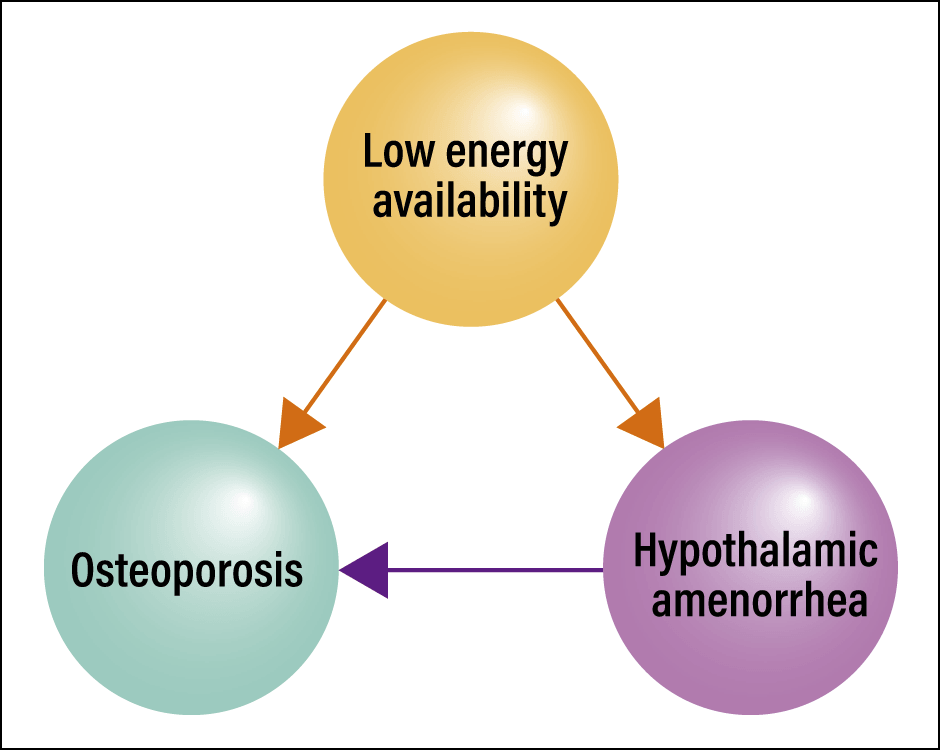
Figure. The female athlete triadAlong with weight changes, menstruation is an indicator of health in female athletes. This is because low energy availability brings a risk of low body weight, low nutrition, and hypothalamic amenorrhea, while amenorrhea in turn leads to reduced bone density.
“Hypothalamic amenorrhea refers to a condition in which a woman has reached the age of 18 or over without having her first period, or whose periods have stopped for at least three months,” Ishii explains. “Ongoing LEA causes a decline in the rhythmic secretion of luteinizing hormone, resulting in menstrual irregularity or amenorrhea. If amenorrhea occurs, the ovaries secrete less estrogen. Estrogen is also related to bone metabolism, and a fall in the quantity secreted causes a reduction in bone density, making the individual more vulnerable to osteoporosis. The term ‘female athlete triad’ describes this vicious circle. In addition, as first menstruation is linked to physical development, a female athlete’s physique needs to be evaluated. In very rare cases, the absence of menstruation might be caused by a congenital abnormality of the uterus, ovaries, or vagina, so I recommend that young women seek advice from a gynecologist if they have not started their period by the age of 15.”
The results of a survey conducted by the Japan Institute of Sports Sciences between 2011 and 2012 among 683 of Japan’s top-level female athletes showed that around 40% of them had menstrual cycle abnormalities, including amenorrhea. Looking at the proportion with amenorrhea by sport, the percentages were highest among athletes in such sports as artistic gymnastics, rhythmic gymnastics, and figure skating, followed by those competing in long-distance track and field events. This study was the trigger for Ishii’s becoming involved in research into menstruation among female athletes.
“Between May 2015 and February 2016, I provided nutritional guidance for three months to six top athletes with amenorrhea who had consulted the gynecology department at the Japan Institute of Sports Sciences and examined changes in their energy availability and luteinizing hormone levels before and after the nutritional guidance intervention. The results I obtained proved that improved energy availability is crucial to improving luteinizing hormone levels,” she says.
She has continued her research into menstruation since then but has also begun looking at male athletes experiencing health problems due to low body weight and LEA, such as stress fractures.
“A key factor increasing the tendency toward low weight is athletes’ preference for lightness,” she points out. “Quite a few athletes —— male and female alike —— believe that a lighter body performs better. We also see LEA among para-athletes (athletes with disabilities, who compete in para-sports). It’s not uncommon for an athlete to actually not be consuming an appropriate level of nutrients, even if they themselves think they are.”
Amenorrhea as a trigger for nutritional support intervention
The preference for a low body weight is a global issue. If LEA persists due to sport, it is referred to as Relative Energy Deficiency in Sport (REDs). Accordingly, the International Olympic Committee (IOC) has sounded the alarm about REDs, identifying it as “a syndrome of deleterious health and performance outcomes experienced by female and male athletes exposed to low energy availability.”
Studies of the health risks of this syndrome for male athletes are being conducted both within Japan and overseas. Scientists have pointed out that functional hypothalamic hypogonadism could be a potential indicator of the health risks of LEA for male athletes, in a similar way to hypothalamic amenorrhea in women, Ishii says.
“In the case of female athletes, the presence or absence of menstruation is widely known to be an indicator of health risks. As amenorrhea is also connected to fertility (ability to conceive or maintain a pregnancy), amenorrhea may even be the trigger for intervention with medical or nutritional support. However, no such indicators currently exist for male athletes. Given that a decline in sexual function is a sensitive issue, I don’t think it’s feasible to ask about it as an indicator when an athlete seeks advice about nutrition and diet.”
Even if an athlete is facing the problems of low body weight or LEA, the indicators for intervention or measures to address the situation differ between men and women. This could probably be described as a sex-based difference.
“Low body weight may not only mean a deficiency in the amount of energy, but also a lack of nutrients such as protein, carbohydrates, vitamins, and minerals,” she says. “As a result, athletes may become fatigued more easily, their muscle strength or stamina may decline, and their performance may also deteriorate. For both male and female athletes, it would be fair to say that appropriate nutritional intake is essential to maintain their sporting career and to achieve peak performance.”
The Japanese concept of shokuiku refers to fostering the ability to choose a good balance of foods and apply the principles of healthy eating in everyday life.
“Also vital will be sports shokuiku —— dietary education with a focus on sport —— to ensure that athletes are healthy and capable of achieving peak performance,” Ishii stresses. “I think there’ll be an even greater need for sports shokuiku, not only for athletes themselves, but also for their coaches and family members. And that applies regardless of sex.”
Athletes in their growth period should make use of supplementary meals!
Problems such as anemia, low body weight, and LEA are not uncommon among athletes who are still in their growth period. Caution regarding anemia among athletes of both sexes is needed during their growth period. “In addition to the energy and nutrients required for growth, you also need to supply the energy burned during training,” Ishii says. She also highlights the importance of supplementary meals in supplying energy. “Supplementary meals are light meals used to compensate for the energy and nutrients lacking in breakfast, lunch, or dinner. They aren’t snacks.” Ishii advises athletes to eat a supplementary meal if they feel hungry before training, or if there is a long interval between the end of their training session and dinnertime. However, she also notes the fact that eating supplementary meals can be challenging in educational settings. This is because some schools prohibit students from bringing food. “Back in the day, students used to be forbidden to drink water while training, but now everyone’s fully aware of the importance of rehydration, and it’s recommended that they drink water or a sports drink,” she says. “I hope that sports shokuiku will help to make people aware of the importance of supplementary meals as well, so they can be incorporated appropriately into young athletes’ diets.”