
Scientists long believed that epigenetic modifications were not inherited by the next generation, but rather reset when a new individual was born, because these modifications regulate gene function through mechanisms such as DNA methylation without altering the DNA base sequence. However, research has shown methylation beginning again in the offspring’s somatic cells after fertilization. More specifically, it would appear that, rather than DNA methylation itself being inherited directly, a mechanism for reactivating methylation was at work. We therefore cannot deny the possibility that characteristics acquired by the parent might be passed on to the next generation.
Special Feature 1 – What We Have Learned About Epigenetics So Far The potential for acquired characteristics to be passed on to the next generation
composition by Rie Iizuka
illustration by Koji Kominato

Yuta Takahashi
Associate Professor, International Research Center for Medical Sciences (IRCMS), Kumamoto University
In 2011, he successfully completed a doctoral program at the University of Tsukuba’s Graduate School of Life and Environmental Sciences, receiving a Ph.D. in Biotechnology. While undertaking postdoctoral training at the Salk Institute for Biological Studies in the U.S., in the laboratory of Professor Juan Carlos Izpisua Belmonte between 2012 and 2022, he developed a DNA methylation editing technology and demonstrated transgenerational epigenetic inheritance in mice. He then joined Altos Labs, Inc. in 2022, and took up his current post in 2024. Heading up the Laboratory of Epigenetic Inheritance, he is dedicated to shedding light on the mechanism involved in the transgenerational inheritance of epigenetic information.
Genes are regulated as to whether their functions are expressed by a mechanism called epigenetics, without any alteration to their underlying base sequences. Because of this epigenetic mechanism, even cells with the same DNA sequence have different properties.
Is epigenetic information really not inherited by the next generation in mammals?
While epigenetic information is passed on to subsequent generations in some species, such as plants, scientists originally believed that it was not inherited by the next generation in mammals. The starting point for this established theory was probably the idea that a new individual could not be created unless cell characteristics were reset. Our bodies have as many as 37 trillion cells of various different types, such as skin cells, liver cells, and blood cells. However, all these cells can be traced back to a single fertilized egg from which they proliferated. In other words, when it comes to the actual base sequence of genes, all cells basically contain the same information. The reason why each cell type has a different role despite this is that the genes they use, and the timing and extent of those genes’ use differ from one cell type to another. Epigenetics is the mechanism that controls gene use in this way, with each individual cell containing epigenetic information tailored to its particular role.
However, if these cell-specific characteristics were maintained, a new individual could not be generated through reproduction. Accordingly, based on the idea that there was a need to first restore each cell to its original “fresh” state, scientists long believed that epigenetic information basically could not be passed on to the next generation.
Investigation of primordial germ cells and embryos immediately after fertilization has confirmed that epigenetic modifications are actually erased (Figure 1).
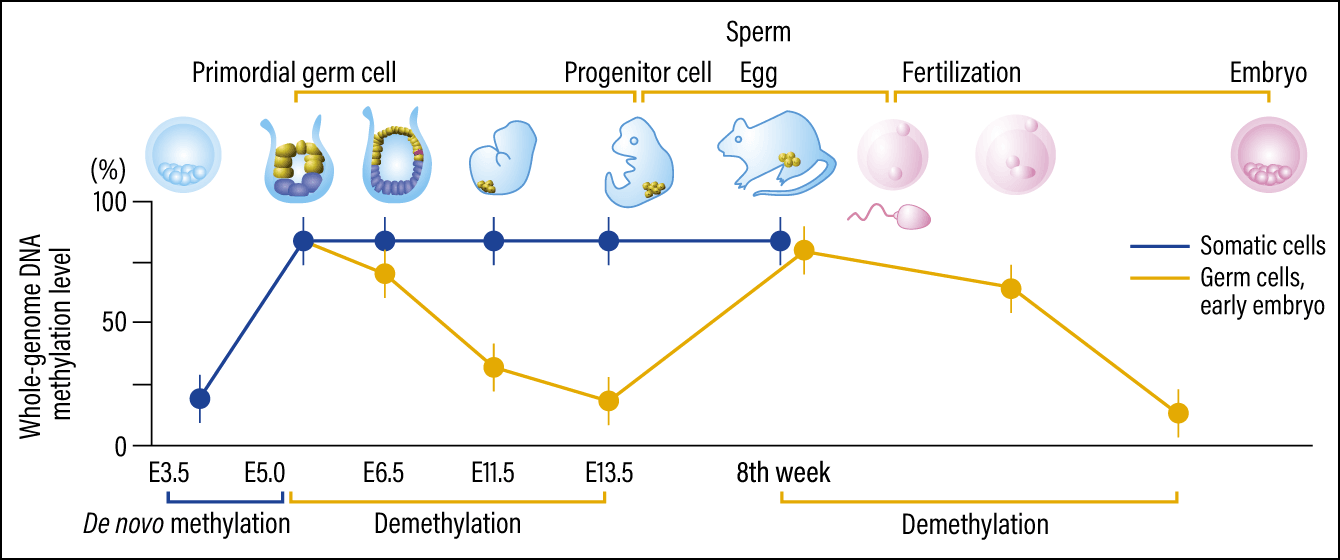
Figure 1. The epigenetic reprogramming mechanism in the germ cell lineageWhole-genome DNA methylation levels in the mouse life cycle. The blue line indicates a high level of genomic DNA methylation in somatic cells. This methylation is established in the early stage of embryonic development. On the other hand, epigenetic reprogramming occurs in germ cells (yellow line). Whole-genome DNA demethylation occurs during primordial germ cell formation, followed by remethylation during the formation of eggs and sperm, and then further demethylation after fertilization.
What has also provided support for this idea is genomic imprinting. Most genes are controlled in such a way that the alleles derived from both father and mother are both expressed or suppressed. In imprinted genes, however, one is inactivated by means of DNA methylation, so that only the other one functions. We know that these epigenetic modifications are erased in primordial germ cells, and that they are reset anew in the gonads according to the sex of the individual. The existence of this reset mechanism has been regarded as evidence demonstrating that epigenetic states are not inherited across generations, as a general rule.
- * Allele: Genes exist at a specific location (locus) on homologous chromosomes derived from the father and mother. In a homologous pair, different types of genes may be located at the same genetic locus; genes in this relationship are called alleles.
In other words, the view that the epigenetic state of the previous generation is reset when a new individual is born has for many years been accepted scientific knowledge, both theoretically and as an observed fact.
Epigenetic inheritance is hard to prove
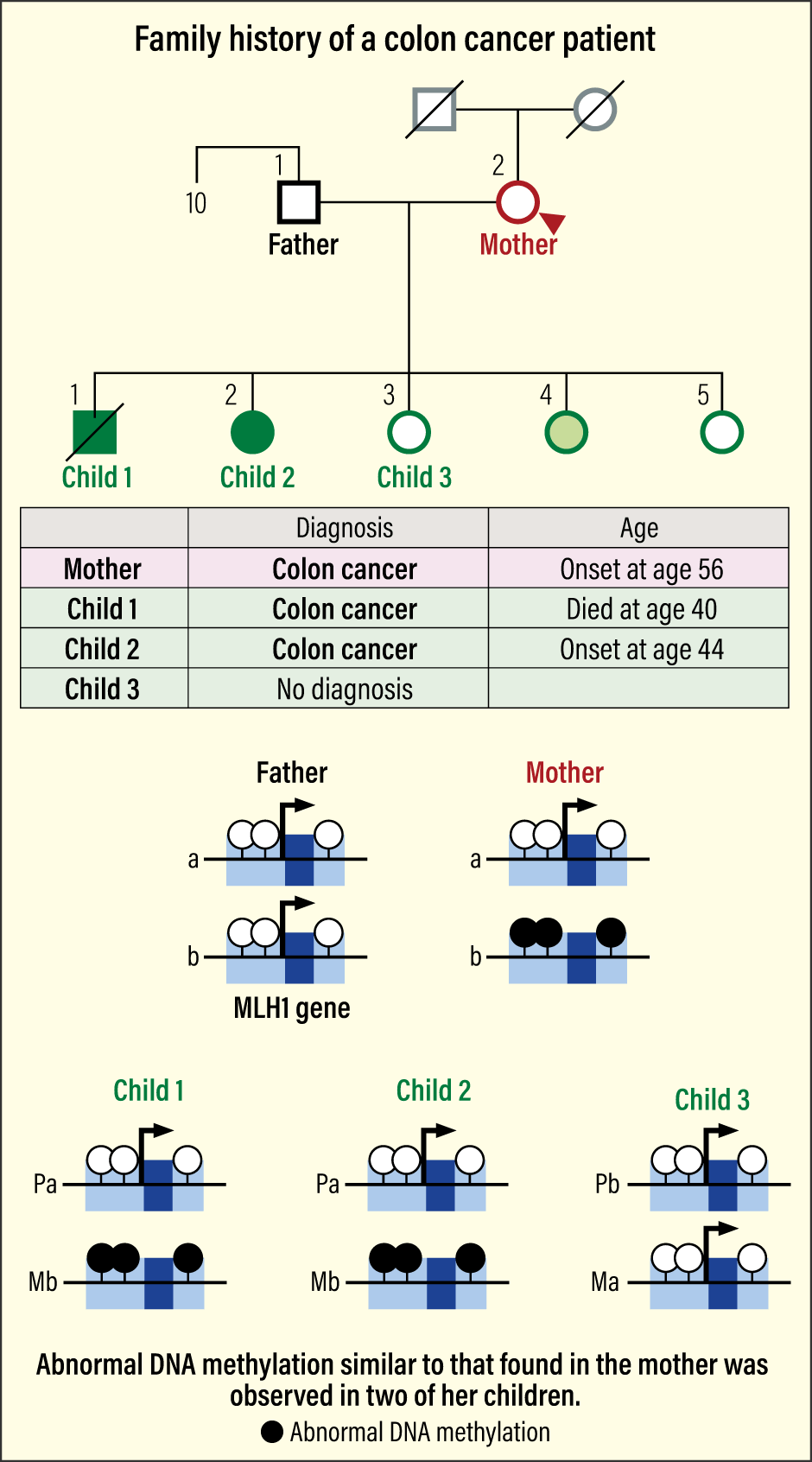
At the same time, there have been previous reports of cases suggesting that parental epigenetic information might actually be inherited by offspring. In a case published in 2012, involving a woman who had developed colon cancer, two of her five children also developed colon cancer and were found to have the same DNA methylation pattern in the same genes as their mother (Figure 2). This has given rise to the question of whether epigenetic information might, in some exceptional cases, remain without being erased.
 Adapted from M. Crépin et al., Human Mutation, 2012 Jan; 33(1): 180–188.
Figure 2. Example of colon cancer in which similar epigenetic changes were observed in a parent and their childrenAlthough the MLH1 gene is not normally methylated, abnormal methylation occasionally occurs and dramatically increases the risk of colon cancer. A woman who had developed multiple colon tumors and adenomas showed abnormal DNA methylation in this region. Two of her children also developed colon cancer and had epigenetic alterations in regions similar to those seen in their mother.
Epigenetic modifications are added and removed according to the environment. This is because they play a part in maintaining the body’s homeostasis and adapting to environmental changes by triggering the expression of the necessary genes. If abnormal epigenetic modifications arising from lifestyle or the environment are passed on to the next generation, they could potentially affect that generation’s health in the future.
Accordingly, I have undertaken research using mouse models in an effort to prove empirically whether such epigenetic modifications really are inherited across generations.
The problem was that I could not completely rule out the possibility that mutations that appeared at first glance to be epigenetic were actually secondary results of mutations in the DNA sequence itself. Although there had been reports that epigenetic information appeared to be inherited in mice in experiments, proving that epigenetic inheritance was occurring was technically difficult at that time, so they went no further than reporting the phenomenon itself. For example, if a mutation occurs in a particular gene’s DNA sequence, it may have the effect of altering the epigenetic state of its surroundings. Studies up to that point had unfortunately not managed to prove that this was purely epigenetic inheritance independent of any mutation in the DNA sequence.
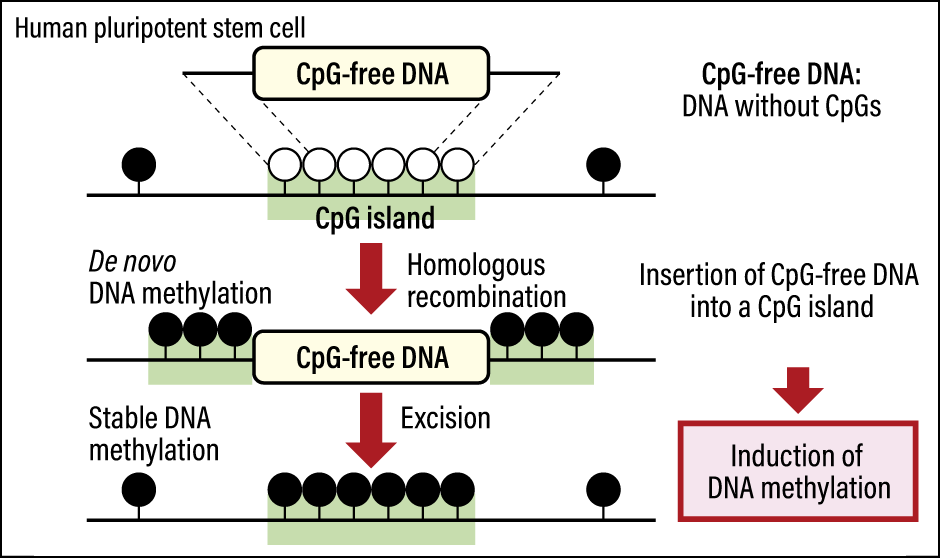
What made it possible to prove this was the DNA methylation editing technology that we developed in 2017 (Figure 3). This technology introduces DNA methylation into a specific location without altering the DNA sequence at all. It is effectively like installing a methylation switch that is pressed once to alter the state of the gene, with the switch itself then immediately being removed. This technology can be used for such purposes as investigating the causal relationship between epigenetic abnormalities and diseases. For example, abnormal methylation in a specific location is often seen in cancer and a number of other diseases. However, it was previously difficult to determine whether the methylation was the cause of the disease or its result. Using this editing technology, we are now able to investigate the cause of diseases by artificially introducing a specific abnormal methylation pattern into normal cells. If we identify that the methylation abnormality is the cause, it might potentially lead to the development of a therapy targeting that area.
 Y. Takahashi et al., Science, 2017 May; 356(6337): 503–508.
Figure 3. DNA methylation editing technologyCpG islands are mostly promoter regions of genes where CpG sequences—sequences where cytosine (C) is followed by guanine (G)—are concentrated. They are not normally methylated. DNA methylation editing is a technology for introducing DNA without CpGs (CpG-free DNA) into CpG islands to methylate them. After methylation, the CpG island remains methylated, even after removal of the introduced CpG-free DNA.
The possibility that information lingers across generations
Using this technology, we undertook an experiment in which we sought to distinguish between genetic and epigenetic inheritance. This enabled us to verify whether epigenetic information really is passed on across generations.
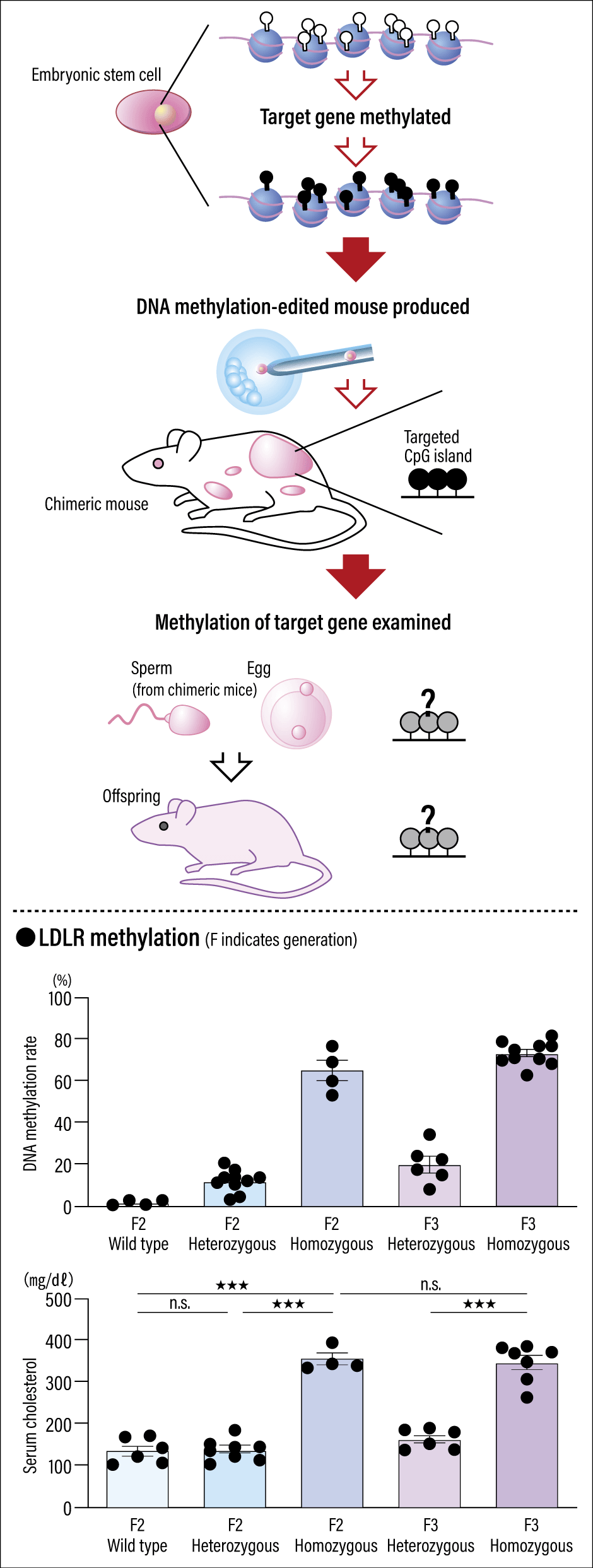
In the experiment, we created a mouse model that had been subject only to manipulation of its epigenetic information, without alteration of its DNA sequence, and then ascertained whether that information was maintained and affected the phenotype. Whereas the target gene in the parent mice was virtually 100% methylated, our investigation of their offspring showed a methylation level of around 50% in individuals that had inherited that allele from their father. This means that the artificially introduced methylation was passed on to the offspring via germ cells. From this result, we discovered the possibility that epigenetic information might linger across generations, without being completely erased in the process of development (Figure 4).
 Y. Takahashi et al., Cell, 2023 Feb; 186(4): 715–731.
Figure 4. Verification of transgenerational epigenetic inheritance using DNA methylation-edited miceUsing DNA methylation editing technology, the research team produced DNA methylation-edited mouse embryonic stem cells and then DNA methylation-edited mice. When they examined whether the DNA methylation and associated phenotype were passed on to the offspring, the researchers found that expression of LDLR mRNA and protein in the liver was repressed, consistent with the methylation status. In addition, cholesterol levels were elevated in the offspring. This suggests that DNA methylation and associated phenotypes can be inherited by the next generation.
Although this experiment revealed the possibility that methylation might be passed on to the next generation, it also raised an even bigger question: how is this methylation inherited? As described above, cells have a mechanism called epigenetic reprogramming, in which epigenetic information is reset in two stages in the process of development, and methylation is meant to be erased as part of this.
Accordingly, during the developmental process of these experimental mice, we conducted an experiment to investigate in greater detail the state of methylation in primordial germ cells, where the first major demethylation occurs during development. As a result, we discovered that DNA methylation is temporarily erased.
However, some highly interesting things occurred after that. For example, no DNA methylation was observed in the sperm of the F1 generation. But when we examined the offspring born from that sperm, DNA methylation had reappeared in their somatic cells. Moreover, it was being maintained at a stable level. In other words, although the sperm and egg carried DNA in a demethylated state into the next generation, methylation in the genes occurred once again in somatic cells after fertilization. This made me think that, rather than DNA methylation itself being directly inherited, there might be some kind of residual epigenetic memory that re-introduced methylation into the genes. That is to say, this information is carried into the next generation and the same abnormal methylation occurs again as a result. The phenomenon could be likened to a gene having a tendency of its own: even if the methylation is removed, it somehow returns to the same state. The question of what this epigenetic memory might be is one of my current research topics.
The ideas of Darwin and Lamarck
In explanations of genetics and evolution, the ideas of Charles Darwin and Jean-Baptiste Lamarck have long been contrasted with each other. In Darwin’s view, organisms have individual variations from the outset, with only those best adapted to the environment tending to survive. To take the example of giraffes, those born with long necks were able to eat leaves higher up on trees and thus survived more easily, so their genes were passed on. In contrast, Lamarck believed that organisms altered their bodies during their lifetimes through effort and experience, and that those changes were then passed on to their descendants. His view was that giraffes that made the effort to stretch their necks so that they could eat the leaves on tall trees developed longer necks as a result and that their offspring then inherited those longer necks.
Leaving aside whether Lamarck’s ideas were correct, our experiments suggest that epigenetic changes can be inherited, meaning that characteristics acquired by parents might be transmitted to the next generation.
Just like gene mutations, some epigenetic abnormalities probably occur by chance, while others are altered by behavioral or environmental impacts. Nevertheless, experiments have now shown that the phenomenon whereby these abnormalities are passed on across generations can occur.
At this point, we do not yet know whether such transgenerational epigenetic alterations occur in humans as well—for example, whether epigenetic information arising from unhealthy lifestyles really can be passed on to a person’s offspring, and which aspects of the epigenetic state of germ cells such lifestyles affect. That is precisely why I believe it is vital for us to understand the mechanisms involved. If we understand the mechanisms, we might be able to determine what kind of epigenetic information is erased and what kind remains in the next generation. I believe that this will be the first step toward being able to explain the relationship between the environment and genetics in the true sense.
(Figures courtesy of Yuta Takahashi)