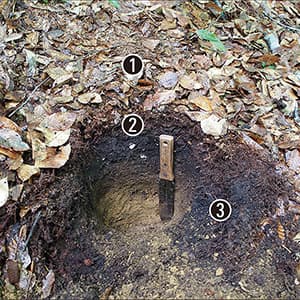

Soils around the world each have their individual characteristics, which are influenced by such environmental factors as climate, topography, parent material, biology and time. The black soil mainly found extensively across the Eurasian Steppe and other regions with a semiarid steppe climate is soft, rich in both organic matter and mineral nutrients, and highly productive. The lack of rain in deserts means that nutrients do not get washed away, so the soil is rich in minerals. However, some land has been degraded by human activity; for example, irrigation has caused salinization in Kazakhstan, while overcultivation in Niger has been responsible for wind erosion. Scientists are engaged in ongoing efforts to understand the diversity of soils and explore measures that also take into account sociocultural characteristics.
Special Feature 1 – Delving into the Mysteries of Soil! The world’s diverse soils are closely linked to human activity
composition by Rie Iizuka
Takashi Kosaki
Professor Emeritus and Senior Visiting Researcher, Institute of International Affairs, Aichi University
Graduated from Kyoto University. Holds a Ph.D. in Agriculture. After holding positions including research scientist at the International Institute of Tropical Agriculture (IITA) and professor at Kyoto University, he took up his current post in 2023. His areas of interest are soil science and global environmental science. Addressing a diverse array of soil degradation problems, principally in Africa and Asia, he is continuing his research into establishing sustainable land use methods, and has also been working on soil and environmental education in recent years. He has served as president of both the Japanese Society of Soil Science and Plant Nutrition and the International Union of Soil Sciences. Among the awards he has received are the Japan Prize of Agricultural Science and the International Soil Science Award of the Soil Science Society of America.
I am sure that everyone played with soil when they were a child. Sometimes, in my university classes, I ask the students, “When you painted pictures as a child, what color was the soil?” Students from the Kanto region are likely to reply that it was dark brown or black. As I am from Osaka, I tend to associate soil with the color ocher. Thus, while soil is a very familiar ecosystem, if we take color as just one example, its properties differ considerably from one region to another.
A philosophy rooted in the color of the soil
Before explaining about soils of the world and their food productivity, I would like to touch upon the fact that each country’s culture is heavily influenced by its soil.
Ancient China had a philosophical system called Wuxing (the Five Elements); the Four Gods that appear within this system are said to be divine creatures that preside over the cardinal directions. The Azure Dragon of the East, the White Tiger of the West, the Vermilion Bird of the South, and the Black Tortoise of the North respectively take the colors blue, white, red, and black. One could go so far as to describe these four colors as the primary colors of soil.
The birthplace of Chinese culture is a region called the Central Plains, located around the middle to lower reaches of the Yellow River. If we look at China’s territory with the Central Plains as the midpoint, we can see that the soil to the east is blue, that to the west is white, that to the south is red, and that to the north is black. I was amazed to discover that this grand philosophy established more than two thousand years ago has its roots in the actual color of the soil found in each region.
The Mesopotamian civilization developed in a region that stretches from the modern countries of Iran and Iraq all the way to Syria. Among the legends of that time is a tale in which mistreatment of the soil caused a god to appear from the soil and scatter salt all around, rendering the soil too saline for anything to grow. This is thought to refer to a phenomenon called salinization, in which the evaporation of moisture in soil causes salt to accumulate on the soil’s surface and become increasingly concentrated, which inhibits plant growth. This means that, even back in those days, people understood the phenomenon of salt damage and its root cause, and incorporated it into their tales in an instructive manner.
Produced during the Nara period (710–784 CE) by various provinces at the instruction of Empress Genmei, Japan’s surviving Fudoki manuscripts are geographical descriptions recording such matters as each area’s place names and produce, including records of the productivity of local soil. While modern Japan offers few opportunities to consider land productivity, in days of yore, the productivity of the soil was a matter of tremendous concern to the government of the day from the perspective of establishing an appropriate taxation system. In that sense, I believe that soil science is the very foundation of managing a nation.
Now that I have explained the sociocultural aspects, let us look at soil around the world from a scientific viewpoint.
Soil science as a modern science began with research conducted in the latter half of the 19th century by Russian geologist and geographer Vasily Dokuchaev. Dokuchaev classified the soils of the world on the basis of his belief that soil properties were determined by a combination of five formation factors: geology (the parent rock and sediment), climate, biology, topography, and time.
The most highly productive soil in upland farming
Today, the world’s soils are broadly classified into 32 groups in the World Reference Base for Soil Resources (WRB), which is endorsed by the International Union of Soil Sciences (IUSS) and widely used by such bodies as the Food and Agriculture Organization of the United Nations (FAO). Under the U.S. Department of Agriculture (USDA) Soil Taxonomy, they are classified into 12 orders.
If we look at a distribution map of the latter, we can see that, as expected, similar soils are formed in places with similar formation factors such as climates and topography (Figure 1). Let us look at soils around the world.
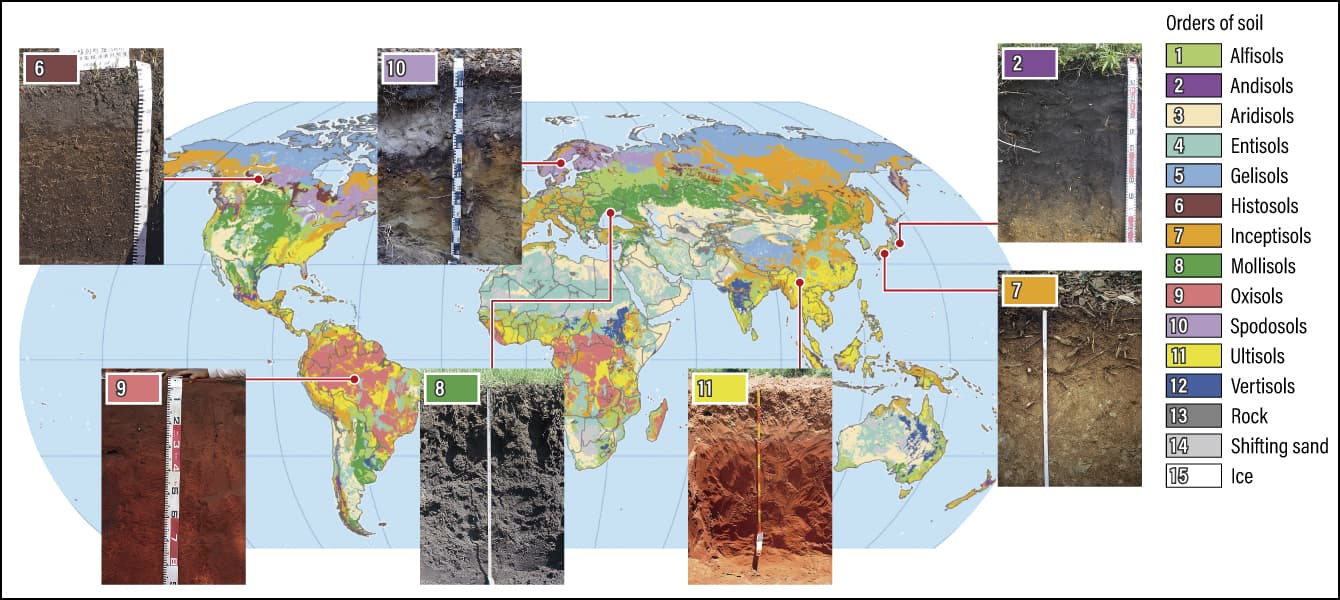 modified from USDA (2005)
Figure 1. Global soil distribution mapThis is the taxonomy of the world’s soils developed by the USDA. In addition to the 12 types of soil that function as areas where food production is actually possible, there are three types of areas without soil: rock, shifting sand, and ice.
The Eurasian Steppe, which includes Ukraine and Kazakhstan, the North American prairies of Canada and the U.S., and Argentina’s extensive Pampas all have a semiarid steppe climate and fertile black soil (called Mollisols in the USDA taxonomy). “Molli” is derived from the Latin word mollis, meaning soft, while “sol” is derived from solum, meaning soil. Soft black soil contains an abundant accumulation of mineral nutrients and organic matter called humus, which is formed when plants, for the most part, are decomposed and transformed by microorganisms. Mollisol is the most highly productive soil in upland farming. It would be no exaggeration to say that, as some of the foremost wheat-growing areas, these regions produce virtually all the world’s bread and pasta. The world’s major powers are located in these regions, and many wars have been fought with the aim of seizing this land. Both Napoleon and Hitler invaded what was then Russia, in an effort to capture Ukrainian territory.
On the plateaus of Central Africa and South America, one sees a lot of red soil with a low level of productivity, due to “rust” formed by the oxidation of iron in the soil as a result of the humid climate.
In the course of the soil’s exposure to rain and wind for millions of years, the three major plant nutrients—nitrogen, phosphates, and potassium—are washed away, along with other elements such as calcium and magnesium, whereas iron becomes insoluble after reacting with oxygen and builds up in the soil. This is why the soil turns red. Soil and plants have a cyclical system in which plants absorb nutrients in the soil and produce starches (organic matter) via photosynthesis, before returning to the soil when they die. However, red soil (Oxisols) has a relatively high iron content, because the nutrients are washed away. One might go so far as to liken this soil to the leftovers from making stock.
One hardly sees any examples of this kind of old red soil in Japan. As Japan has volcanoes, as well as precipitous mountains prone to erosion, its soil rarely stays in the same place for long periods.
What Japan has in abundance is volcanic ash soil and young acidic soil of the kind found on plains formed by the repeated flooding of rivers. Japan’s soil is new, with even the oldest dating back only tens or hundreds of thousands of years, while the andosols that are widely distributed around the country are about 10,000 years old, at most. One can see just how young that is if one compares it to the soil in Scotland, which dates back 500 million years.
Desert soil is the richest in nutrients. This might seem surprising, but deserts contain an abundance of minerals, including not only sodium, but also phosphates, potassium, and calcium, because the lack of rainfall means nutrients do not get washed away.
The Mesopotamian and Egyptian civilizations succeeded in achieving high levels of food production by using water channeled from major rivers (irrigation), along with abundant sunshine and the intrinsically fertile soil of the desert.
However, using the wrong irrigation method causes salt damage. Adding water to land that did not originally have groundwater creates an artificial aquifer in the layer below the surface soil in which crops are grown. When this happens, a phenomenon called capillary action occurs, in which the groundwater percolates up into the surface soil. In the process of the water percolating up, salt and other substances dissolve, and the salt concentration gradually increases. The moisture evaporates, but the salt and other substances remain in the soil, turning it a whitish color.
What happens when crops are cultivated in soil with high salt levels? I often use the example of nukadoko, a bed of rice bran used in Japanese cuisine for pickling vegetables. When vegetables are grown in soil with a high salt content, the moisture in the vegetables leaches out like in pickles, causing them to shrivel and leaving them unable to absorb nutrients via their roots, so they die. This accumulation of salt in soil is called salinization and is one type of soil degradation. Salinization often occurs in desert land, but it can even occur in semiarid areas such as Ukraine, ruining precious fertile land, so proper management is required.
Degraded in just 30 years due to salinization
We have conducted surveys of agricultural land across the globe, but irrigation is not a simple solution, as the situation differs from one place to another. Even where soils appear at first glance to be the same, an elevation difference of just 10 cm or so can be crucial, with land at the higher elevation being fine, but salt rising to the surface in the lower-lying land. It is not easy to wash away this salt once it has emerged, and doing so costs huge sums of money.
In Kazakhstan, I witnessed a case in which salinization caused farmland soil to degrade in just 30 years.
Between the 1960s and the 1990s, Kazakhstan forcibly increased agricultural output while it was still part of the territory of the Soviet Union. Motivated by the dramatic shrinkage of the Aral Sea, we went to Kazakhstan, and it really did seem as though the land was being consumed. The Syr Darya, a river whose source is located in the Tianshan Mountains, flows into the Aral Sea, which is a huge lake that can be seen on any globe. However, it has now dried up almost entirely. As a result of huge amounts of water being drawn from the Syr Darya to irrigate Kazakhstan’s desert, water stopped flowing into the Aral Sea and it gradually shrank. People familiar with the situation locally had predicted this result, but boosting output was the top priority under the five-year plans of the former Soviet Union. When salt damage made the land impossible to farm, people ended up abandoning it and moving to farmland elsewhere. The abandoned land could only be used as pasture for sheep and goats. In quite a few cases, even that pastureland turned into semi-desert once the grass dwindled.
This kind of land consumption did not necessarily occur because this area was part of what was the Soviet Union; the same phenomenon also occurs in the U.S. and Australia, so I believe that appropriate land management is a global issue that continues today.
Whereas Kazakhstan was an example of salinization, in Niger, we addressed the problem of wind erosion (Figure 2). Wind erosion was also depicted as the social background to John Steinbeck’s The Grapes of Wrath. This is a problem in which wind blows soil away, reducing the fertility level of the remaining soil.
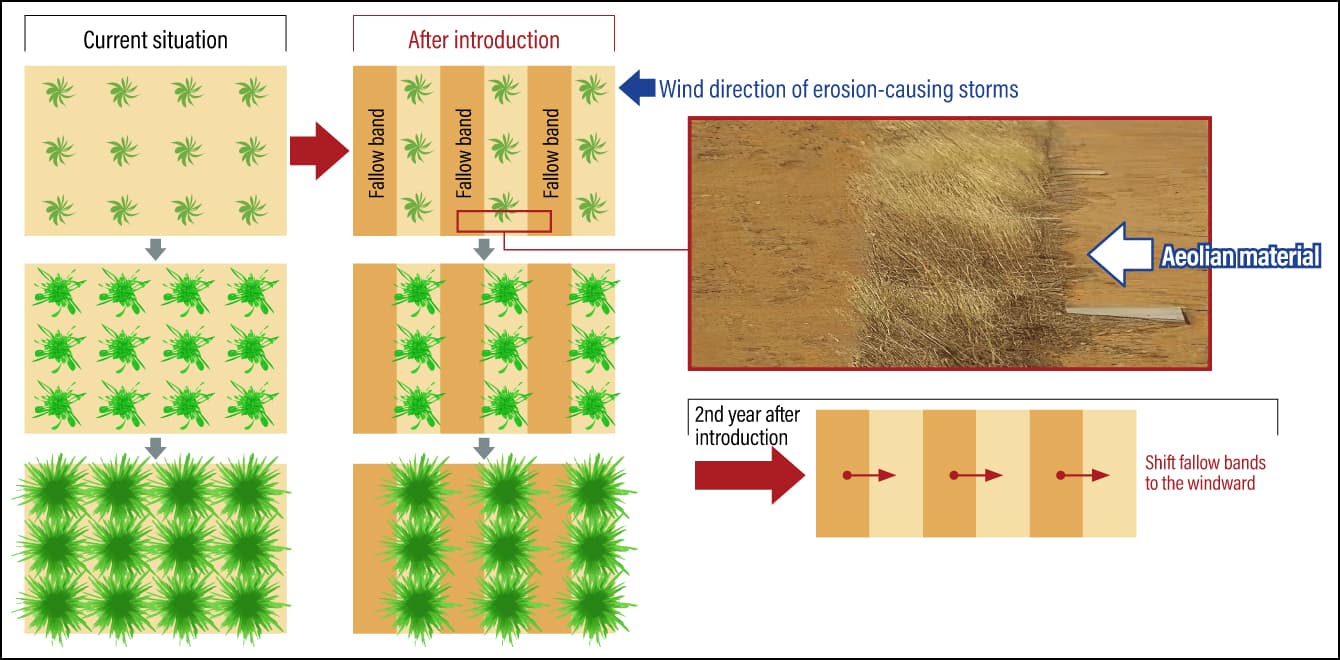 modified from Ikazaki et al. (2011)
Figure 2. Fallow bands in fields in NigerAlternating fallow and cultivated bands are arranged in a single field to prevent soil from being dispersed by the wind. Understanding and acceptance by local people are also essential.
Niger’s fields were becoming progressively desertified. The farmers there cultivate pearl millet (Pennisetum glaucum), but strong winds blow the soil around, dispersing the nutrients. Accordingly, the farmers undertook shifting cultivation by rotating cultivated land and fallow land every few years, but population growth meant they faced the need to increase output.
We first visited the area and conducted a survey, which resulted in our research team proposing a method called the Fallow Band System. The key to this method is creating both fallow and cultivated bands within a single field. Although they are called fallow bands, the method actually just involves allowing grass to grow; the soil and nutrients blown around by the wind catch on the grass and fall to the base of plants, preventing nutrients from being lost from the soil. We created a system that would enable the farmers to make good use of the land by using the fallow band as a cultivated field and the cultivated field as a fallow band the following year.
However, even though we devised the idea for the fallow band system, we had to undertake repeated on-site surveys and experiments in order to find the optimum method for the location in Niger. After gathering particles scattered by the wind, and investigating what types and quantities of particles blew around at what level of wind speed, and what length of grass would be needed to trap them, we found a balance that would maintain productivity while avoiding damage to the soil. Even if we think our method is good, local people will not be satisfied with it if it requires too much extra effort or imposes excessive costs, and they will not adopt the system. Accordingly, we explore support methods based on a hands-on approach, while observing the environment and the reactions of the local farmers.
Rice paddies are a sustainable method with little soil degradation
When it comes to Japan, I believe there is little cause for concern about soil degradation. Although cases of salinization do occur in greenhouse cultivation, Japan’s high rainfall means that soil can recover, and with rice paddies at least, there is no possibility of wind erosion.
While rice paddies require considerable effort, they give rise to little soil degradation, making them a sustainable method compared with upland farming. At present, paddy rice cultivation is principally carried out in South, Southeast, and East Asian countries. This region accounts for about half the world’s population, but just 12% or so of its land area. From this, one can understand that paddy cultivation is a highly productive agricultural method capable of supporting a large number of people per unit of land area. I believe this farming method should be passed on to future generations in Japan and other Asian countries.
However, there is no single universally applicable method that is beneficial for soil and suitable for every part of the globe. Techniques for preventing soil degradation and maintaining the soil environment differ from one environment to another. Even the question of what constitutes healthy soil to start with differs according to the ecosystem. In order to keep the world’s soils healthy, I believe it is crucial to understand soil diversity and explore optimal solutions that take into account not only the ecosystem, but also sociocultural characteristics.
The reason why we provide support for conserving agricultural land and strengthening ecosystem functions in various parts of the world is because we feel a sense of crisis regarding the fact that soil is being used up. Soil is key to nutrient cycling in ecosystems and supports almost all forms of life on Earth. Those familiar with the field of soil science believe that our planet’s soil is capable of meeting the food needs of around 10 billion people. However, this is only possible if the soil is managed with proper and optimal care, avoiding wars or regional conflicts which directly reduce farming areas, and indirectly trigger or accelerate soil degradation, leading to a drastic decline in current and future food production. In fact, there are major regional differences in production capacity, and the problem of how to distribute food still remains. Alternatively, technologies such as plant factories that do not rely on soil might advance, but the situation in which we are currently reliant on soil for at least 95% of our food production is unlikely to change any time soon. I believe we need to properly manage land to prevent its depletion, ensuring that farmland is not abandoned and land capable of being used for food production is not repurposed for other uses.
Those of us involved in the field of soil science are also engaged in awareness activities across the globe, focusing on soil and soil science. The IUSS has designated the period from 2025 to 2034 as the Decade of Soil Sciences for Sustainable Development, and is undertaking activities aimed at promoting a deeper understanding of soil among a larger number of people.