
The possibility that climate change might have a substantial impact not only on the body but also on the mind has emerged from approaches adopted in an academic discipline called economic statistics. Scientists suggest that global warming and natural disasters may cause mental health to deteriorate, resulting in an increase in psychiatric disorders such as depression. There is also data indicating that crime rates increase as temperatures rise. The WHO has pointed out that climate change poses a serious risk to mental health. In addition to measures to curb temperature rises, we need a health care system that supports both mental and physical health.
Special Feature 1 – Climate Change and Health Risks Using statistics to interpret the causal relationship between climate change and mental health
text by Toshiko Mogi

Hironobu Miyazaki
Professor, Department of Economics, Faculty of Economics, Nanzan University
Born in 1973 in Mie Prefecture. After successfully completing a master’s program at Kyoto University’s Graduate School of Economics in 1998, he joined the Central Research Institute of Electric Power Industry, and went on to obtain a Ph.D. in economics from the Graduate School of Economics at Kyoto University in 2006. He was appointed an associate professor in the Faculty of Economics at Nanzan University in 2009, and a visiting researcher at the University of California San Diego, U.S. in 2014. He took up his current position in 2024. In recent years, he has also been undertaking interdisciplinary research with a focus on medicine. His research interests are economic statistics and applied econometrics.
It has been suggested that climate change may worsen people’s mental health, and that this deterioration in mental health may lead to an increase in crime rates. This finding was made in an article entitled “An Empirical Analysis of the Impact of Global Warming and Natural Disasters on Mental Health.” written by Professor Hironobu Miyazaki of Nanzan University, an economist who specializes in economic statistics.
Health is a research topic in the field of economics
Economic statistics is a field that seeks to use economic data to understand social topics and issues. So, how are economics, climate change, and mental health related? That question formed the starting point for this interview.
“I mainly use economic data to carry out empirical analysis of issues posing a problem for society,” Miyazaki says. “Empirical analysis is a research technique that involves verifying how phenomena actually occur, based on data and other evidence. I used to work on finance-related topics, but now my research centers on economic disparities. In the course of this work, I became interested in the mental health impacts of phenomena such as natural disasters and global warming associated with climate change.”
One factor behind this was the changing tide in economics.
“Conventional economics tended to measure economic might on the basis of gross domestic product (GDP),” he explains.
Defined as the total monetary value added by goods and services newly created within a country during a set period, GDP is used as an indicator of economic performance and the scale of economic activity in a country.
“However, there’s debate around the question of whether GDP alone can truly measure the affluence of people’s lives, or whether we should adopt another indicator of well-being, such as people’s happiness,” he continues. “As health has also recently emerged as an important indicator for measuring happiness, health—including mental health—has become a research topic in the field of economics.”
Separately from this trend, new research domains that blend economics with psychology have also emerged, Miyazaki says. Examples of these include behavioral economics, which analyzes economic behavior using psychological approaches, and neuroeconomics, which brings together the fields of economics, psychology, and neuroscience in order to investigate how the workings of the brain influence decision-making in human economic behavior.
“As the focus of economics broadened and blended with a variety of other fields, I myself became interested in its overlap with medicine,” he explains. “I was particularly interested in the relationship between economics and mental health, so I also carried out empirical analysis of the impact of economic disparities on mental health. The results of my research revealed that the negative impact of economic disparities on mental health was also apparent from statistical data.”
After looking at economic disparities and mental health, Miyazaki went on to focus on the topic of global warming and mental health. The fact that global warming has a wide range of adverse impacts on human health has already been pointed out from a variety of perspectives. Concerns about impacts on mental health have also been expressed. The fact that climate change poses a serious risk to mental health has even been highlighted in a 2022 report published by the World Health Organization (WHO), entitled Mental health and Climate Change: Policy Brief.
“When I examined prior research about global warming and mental health, I encountered such terminology as ‘ecological grief’ (a sense of profound sadness or loss about losing ecosystems due to climate change and the like), ‘eco-anxiety’ (a state of anxiety or stress arising from the critical situation faced by the global environment), and ‘climate anxiety’ (a chronic state of anxiety and similar emotions stemming from climate change) in fields including environmental psychology in the U.S.,” Miyazaki says.
Using objective figures for empirical analysis of relationships
Environmental psychology is a field that researches how the environment influences human psychology and behavior. As Miyazaki read extensively through literature from previous studies, he found that researchers had pointed out that eco-anxiety and the like had a negative impact on happiness, and that this negative relationship was particularly apparent among younger age groups, women, and people in impoverished developing countries. It has also been pointed out that incidents of violence tend to increase during prolonged periods of high temperatures, due to the tendency for frustration to build up and lead to aggression, as well as the fact that the aftermath of natural disasters is associated with a rise in depression, anxiety, post-traumatic stress disorder (PTSD), drug abuse, and domestic violence, among others.
However, as many environmental psychology studies are based on questionnaires conducted among the victims of hurricanes and other disasters triggered by climate change, there is a possibility that the personal emotions, experiences, interpretations, and biases of the respondents affect the content of their responses.
“Accordingly, focusing on Japan, I decided to use statistical data to conduct an empirical analysis of the relationship of climate change and resultant natural disasters to mental health, employing a technique called regression analysis and using highly objective figures, in order to ascertain whether there really is a causal relationship, and the pathways through which they affect mental health,” he explains.
Regression analysis is a statistical technique that clarifies in the form of a mathematical function (formula) the extent to which several “factors (causes)” (in statistical terminology: explanatory variables) affect an “outcome (response you wish to analyze)” (in statistical terminology: response variable / explained variable).
However, quantifying mental health is difficult.
“Referring to prior research into relationships with mental health, I used the depression rate, suicide rate, and crime rate as indicators of mental health, employing them as what are called ‘proxy variables’ in the field of statistics,” he continues.
In the case of the depression rate, he divided the number of patients with depression in each prefecture by that prefecture’s population to obtain figures per 100,000 population. Similarly, for the suicide rate, he divided the number of suicides in each prefecture by that prefecture’s population to obtain figures per 100,000 population. For the crime rate, he divided the total number of recognized crimes under the Penal Code in each prefecture by that prefecture’s population to obtain figures per 100,000 population (Table 1).
Table 1. Basic statistics
| Sample size | Mean | Standard deviation | |
| Depression rate | 280 | 587.223 | 138.046 |
| Suicide rate | 282 | 9.590 | 4.353 |
| Crime rate | 141 | 666.546 | 266.313 |
| Maximum temperature (°C) | 141 | 3.482 | 0.050 |
| Total loss (¥1,000) | 141 | 15.030 | 1.926 |
| Real gross prefectural product (¥1 million) | 141 | 15.838 | 0.854 |
Note 1:
Figures for depression rate, suicide rate, and crime rate are per 100,000 population.
Note 2:
Maximum temperature, total loss, and gross prefectural product are all logarithmic values.
Note 3:
As it was not possible to conduct a survey in Kumamoto Prefecture in 2016, the sample size for depression rate is 280.
Cited from Miyazaki (2023) “An empirical analysis of the impact of global warming and natural disasters on mental health,” The Nanzan Journal of Economic Studies, Vol. 38, No. 1, p. 52 (in Japanese)
This table shows the sample size, mean, and standard deviation (an indicator of the degree to which the data varies around the mean) for each item.
Figure 1 shows the mathematical formula derived in this way. It expresses the response variable (variable expressing the outcome; in this case, indicators of mental health) using the explanatory variables (variables expressing the causes).
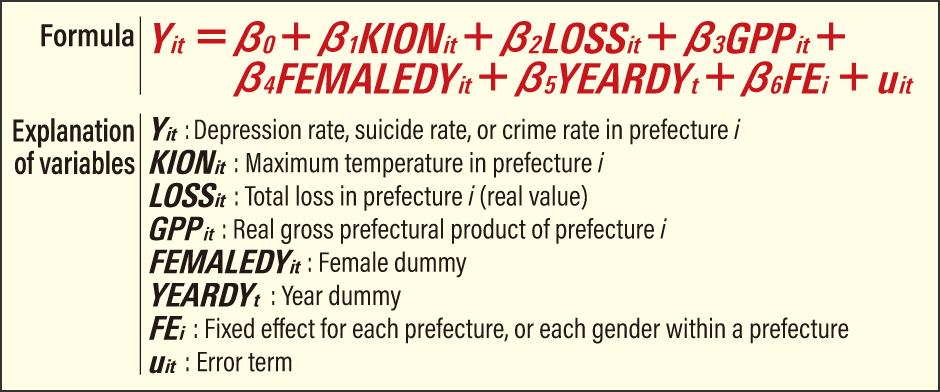 Revised and expanded figure reproduced with the author’s permission from Miyazaki (2023) “An empirical analysis of the impact of global warming and natural disasters on mental health,” The Nanzan Journal of Economic Studies, Vol. 38, No. 1, p. 53 (in Japanese)
Figure 1. Formula
Statistical impacts
Table 2 shows the results derived using the formula. Miyazaki explains how to interpret this table as he guides us toward the results of his analysis.
Table 2. Results of the analysis of mental health
| Depression rate | Suicide rate | Crime rate | |||
| Model 1 | Model 2 | Model 1 | Model 2 | Model 2 | |
| Constant term | -1050.070 (3609.960) |
-1834.184 (2551.619) |
54.507 (43.034) |
31.613 (27.092) |
-1456.833 (2382.829) |
| Maximum temperature | 325.876* (172.820) |
346.880** (147.131) |
0.463 (2.127) |
1.200 (1.376) |
164.385* (93.923) |
| Total loss | 0.954 (2.340) |
0.221 (2.108) |
0.035 (0.032) |
0.024 (0.018) |
3.6188**(1.499) |
| Gross prefectural product | 29.354 (215.302) |
74.652 (161.361) |
-2.461 (2.616) |
-1.581 (1.710) |
107.104 (154.860) |
| Female dummy | 182.943*** (8.033) |
-7.725*** (0.089) |
|||
| Year dummy | YES | YES | YES | YES | YES |
| Prefecture dummy | YES | YES | YES | ||
| Prefecture and gender dummy | YES | YES | |||
| Sample size | 280 | 280 | 282 | 282 | 141 |
Note 1:
***indicates significance at the 1% level, **at the 5% level, and *at the 10% level.
Note 2:
Figures in parentheses indicate robust standard errors.
Revised and expanded figure reproduced with the author’s permission from Miyazaki (2023) “An empirical analysis of the impact of global warming and natural disasters on mental health,” The Nanzan Journal of Economic Studies, Vol. 38, No. 1, p. 54 (in Japanese)
As a result of this analysis focusing on Japan, it became apparent that people’s mental health is deteriorating due to the impact of global warming, and also that the crime rate may be rising as a consequence.
He divided the analytical model relating to mental health into two: Model 1 and Model 2.
“Model 1 assumes that no gender differences are observed at the prefectural level, while Model 2 assumes that a difference exists,” he explains.
Some of the figures for the indicators are followed by asterisks (*).
“Asterisks indicate that it was statistically evident that the variable to the left has an impact.”
In the case of maximum temperature, both the depression rate and crime rate have asterisks next to them. The number of asterisks indicates the significance level: *** for 1%, ** for 5%, and * for 10%. In other words, we can determine that there is a statistically significant impact.
“Maximum temperature affects the increase in the depression rate,” Miyazaki says. “In other words, we can see that the number of patients with depression increases when the temperature rises.”
Similarly, the crime rate rises when the temperature goes up.
“Total loss indicates the total monetary value of the various kinds of loss caused by natural disasters such as typhoons and torrential rain,” he continues. “There’s an asterisk next to the crime rate, which statistically indicates that the crime rate increases when the damage caused by natural disasters is greater.”
There is no asterisk next to suicide rate in the case of maximum temperature. Nor are there any next to the depression rate or suicide rate in the case of total loss.
“Maximum temperature does not affect suicide,” Miyazaki says. “Total loss has no impact on the depression rate or the suicide rate. In statistical terms at least, that is what we can say based on these results of my analysis.”
Other variables include the female dummy.
“There is a statistical technique utilizing a dummy variable, which uses the figures 0 and 1 to express information that cannot be quantified,” he continues. “Using dummy variables, I investigated differences between males and females, and differences across years, among others. Cells containing the word ‘YES’ indicate that I used the relevant dummy variable to investigate differences.”
Looking at the female dummy variable, we can see asterisks next to depression rate and suicide rate in Model 1.
“Statistically, this indicates that when we compare males and females, females have a higher depression rate, but a lower suicide rate.”
Based on these figures, Miyazaki summarizes the results of his analysis as follows.
“Just like the previous studies in other countries, I found that in Japan, too, people’s mental health is deteriorating due to the impact of global warming, and that there is a possibility that the depression rate is rising as a result. And it is possible that the crime rate is going up because of not only the deterioration in mental health caused by global warming, but also the deterioration in mental health arising from natural disasters.”
Improving medical systems regarding depression is an urgent task
Miyazaki embarked on using an economic statistical approach to mental health several years ago, and published an article on his findings in June of 2023. That was the year when temperatures in March recorded levels more usually seen in May, and since then, Japan has seen successive summer heat waves featuring what are described as “abnormally high temperatures that would only be expected to be seen once every 30 years.” Appropriate air conditioner use and self-care to prevent dehydration and heat stroke are imperative, with parasols, hats, and drinks becoming essentials when going outdoors. People are experiencing the impact of temperature rises on health for themselves. One hears some mention being unable to walk their dogs, while elderly people say they have fewer opportunities to go for a walk because it is too hot to go outside. Everyone has felt the effects of high temperatures on the body. But what kind of impact do they have on mental health?
“I don’t really know what kind of impacts are actually emerging, because the medical mechanisms are outside my field of specialism,” Miyazaki says. “However, as I mentioned earlier, statistical data analysis shows that the harms caused by natural disasters and high temperatures due to global warming affect mental health.”
He also points out the need for measures to prevent mental health from deteriorating.
“Specifically, improving systems to enable patients to seek treatment for depression is an urgent task.”
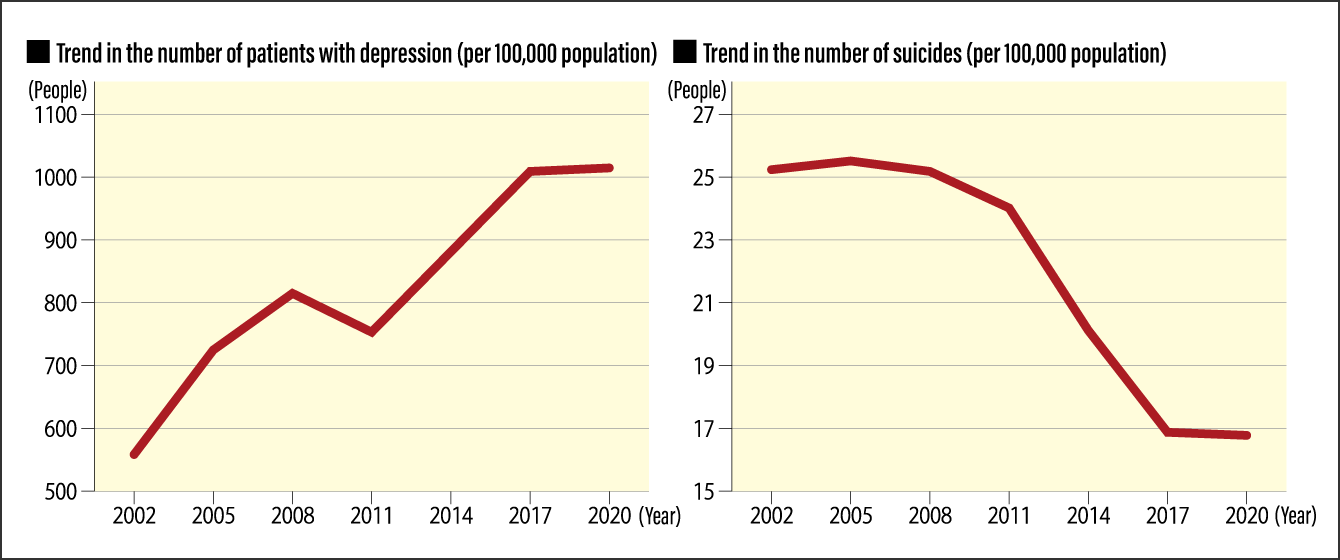
Before conducting data analysis, Miyazaki created a graph indicating the trend in the number of patients with depression per 100,000 population (Figure 2 left). Looking at this, we can see that although the number of patients with depression increased until 2008, it fell from 2008 until 2011, but then resumed its upward trend thereafter.
 Cited from Miyazaki (2023) “An empirical analysis of the impact of global warming and natural disasters on mental health,” The Nanzan Journal of Economic Studies, Vol. 38, No. 1, p. 51 (in Japanese)
Figure 2. Trends in the number of patients with depression and the number of suicidesAlthough the number of patients with depression has increased, the number of suicides has declined. This suggests that effective countermeasures can help prevent individuals from making extreme choices. Going forward, support for strengthening the healthcare delivery system will be essential as a measure for patients with depression.
“One factor behind this may well be the increasingly common awareness that depression is like a ‘common cold of the mind’ that anyone can suffer from,” he explains. “People are now able to disclose that they have depression, rather than hiding it. This is likely to be one factor contributing to potential patient numbers becoming visible.”
At the same time, he says, issues become apparent if we turn our attention to the medical care system in this area.
“Looked at as a proportion of the total population, Japan does not have enough departments of psychosomatic medicine or psychiatrists. Regular consultations are needed in order to treat depression, but even those who wish to seek treatment face the problem of being unable to get an appointment, even for an initial consultation. It would be desirable to have a support system for patients with depression that enables everyone to access appropriate treatment, no matter where in Japan they might be.”
In addition to examining the trend in the number of patients with depression, Miyazaki also created a graph showing the trend in the number of suicides per 100,000 population (Figure 2 right).
“We can see that this trend was flat during the first half of the 2000s, but then fell substantially from 2008 and particularly from 2011,” he points out. “This is likely to be the result of collaborative efforts by the public and private sectors to work on suicide prevention measures, including legal support in the form of the 2006 enactment of the Basic Act on Suicide Countermeasures, the Act for Supporting the Self-Reliance of Persons in Need, and the Basic Act on Measures Against Alcohol-Related Health Harm, and also the enhancement of advice systems. We can expect to see positive effects when appropriate measures are taken.”
The whole of Japan is forecast to see higher-than-average temperatures again in the summer of 2026, with a strong possibility of relentless heat. While taking steps to prevent global warming that will curb rising temperatures, putting in place a health care system that supports both mental and physical health is a matter of urgency.
(Figures courtesy of Hironobu Miyazaki)