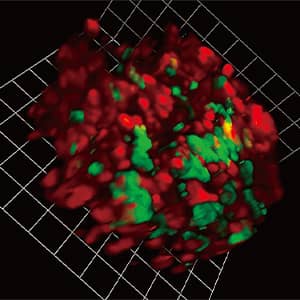
BIOLOGY Special Feature 1 – The Evolution in Visualization Bioluminescence imaging and real-time cell observation Jellyfish, fireflies, and other organisms that emit light have their own unique luminescence mechanism. The first to be discovered was the protein that makes the jellyfish Aequorea victoria glow. Subsequently, this fluorescent protein was applied in the development of in vivo fluorescence imaging, enabling cells and tissues to be observed in real time while still alive. Life sciences research progressed substantially as a result. High-precision visualization is now possible, thanks to the development of imaging techniques that leverage the luminescence mechanisms of various organisms. These techniques are contributing to a multitude of areas, including the kinetic analysis of cancer cells.