
In 1999, the Basic Act on Food, Agriculture, and Rural Areas was enacted, to outline the direction of Japanese agriculture in the 21st century and the framework for agricultural policy. It mandated the formulation of a basic plan every five years. This Basic Act was amended in 2024, for the first time in 25 years. Forming the backdrop to this amendment were the dramatic changes in a variety of circumstances affecting agriculture, including domestic and international development, climate change, and a decline in the farming population due to the aging of agricultural workers. At the same time, initiatives focused on the agriculture of the future are also starting to emerge, such as the establishment of smart agriculture and other such sustainable food systems. Agriculture has reached a major turning point.
Special Feature 1 – The Agricultural Revolution A dramatically changing situation: Japanese agriculture at a turning point
composition by Rie Iizuka
illustration by Koji Kominato
Yasuhiro Nakashima
Professor, Undergraduate School of Nutrition Sciences, Kagawa Nutrition University
Successfully completed a doctoral program at the University of Tokyo’s Graduate School of Agriculture in 1989 and was awarded a Ph.D. in Agricultural Science. He served as a research assistant at the University of Tokyo’s Faculty of Agriculture, and subsequently as an assistant professor, associate professor, and professor at that university’s Graduate School of Agricultural and Life Sciences before taking up his current position in 2025. He is Professor Emeritus of the University of Tokyo. His publications include (as sole author) Shokuhin Anzen Mondai no Keizai Bunseki [Economic Analysis of Food Safety Issues] (Nihon Keizai Hyouronsha), (as author and editor) Shoku no Keizai [The Economics of Food] (Domesu Publishers), and (as co-author) Fūdo Shisutemu No Keizaigaku [An Introduction to Food Economics] (Ishiyaku Publishers). Among other positions, he currently chairs both the Council for the Japanese Agricultural Standards and the National Research and Development Agency Council of the Ministry of Agriculture, Forestry and Fisheries.
The Basic Act on Food, Agriculture and Rural Areas (hereinafter, the “Basic Act”) was enacted in 1999. At the time, it was enacted to uphold four basic principles: ensuring a stable food supply, promoting the multifaceted functions of agriculture, fostering the sustainable development of agriculture, and advancing rural development. The stated purpose of the Basic Act was to stabilize and improve the lives of citizens and achieve sound development of the national economy. Since its enactment, basic plans have been formulated every five years, in accordance with this law.
The first major revision in quarter of a century
More specifically, the Basic Act provides critical guidelines for maintaining and developing Japanese agriculture and rural areas, thereby ensuring food security. Now, the Basic Act has undergone its first major revision in a quarter of a century, to take account of the dramatic changes in the social situation. The six key points are as follows.
- Ensuring food security for every citizen has been established as a basic principle.
- Establishing environmentally harmonized food systems has been established as a new basic principle.
- The direction of agricultural production amid population decline has been defined.
- The need to maintain rural communities amid population decline has been defined.
- The positioning of food systems and the roles of stakeholders have been defined.
- The next basic plan is to be formulated under the amended Basic Act.
Particularly noteworthy is the fact that the term “food security” has been used in the basic principles. Previously, the principles specified in the Basic Act were based on the perspective of securing a stable food supply; rather than merely being a change of terminology, this signifies a switch in the fundamental approach to securing food.
The Food and Agriculture Organization of the United Nations (FAO) defines food security as “a situation that exists when all people, at all times, have physical, social and economic access to sufficient, safe and nutritious food that meets their dietary needs and food preferences for an active and healthy life.” This definition incorporates the following four elements:
- AvailabilityThe availability of sufficient quantities of food on the market through adequate food production, imports, and stockpiling.
- AccessThe economic and physical means to purchase or otherwise obtain food.
- UtilizationWith a sanitary environment and knowledge of food preparation and nutrition, food can be properly prepared, and nutrients effectively utilized.
- StabilityA situation in which the three elements above are stable.
Historically, Japan has often equated food security with food availability, assuming that a stable food supply would suffice. However, it is clear that, even in Japan, challenges such as economic disparities, the absence of commercial facilities in depopulated rural areas, and transportation barriers for the elderly have made food access a significant issue. Accordingly, the concept of food security was reevaluated to address these issues.
While food security initiatives are multifaceted, Japan must prioritize how to produce food domestically and import it from overseas.
It is critical to understand that increasing Japan’s food self-sufficiency rate does not eliminate our dependence on imports. It would not be feasible for Japan to cover all its food needs through domestic production, so we will still require imports from abroad.
At present, domestic production accounts for approximately 40% of the food consumed in Japan on a calorie basis, with the remaining 60% covered by imports (Figure 1). Japan’s low rate of self-sufficiency is frequently highlighted, prompting policies aimed at improving it. While these efforts are valid, a key question remains: why does Japan’s self-sufficiency rate remain low?
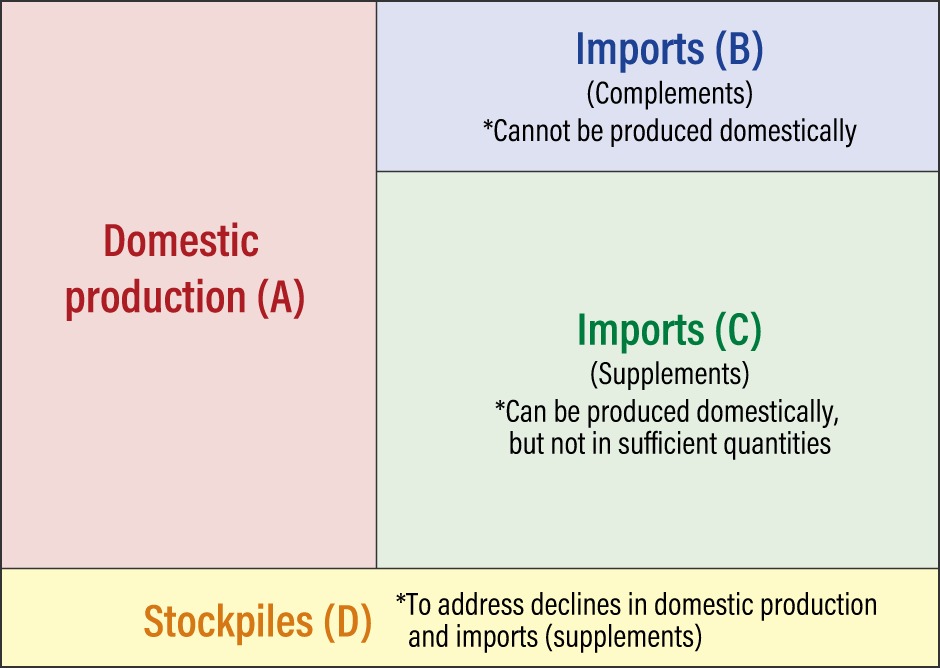
Figure 1. Composition of a stable food supplyOn a calorie basis, 40% of Japan’s food supply is sourced from domestic production, while imports account for the other 60%. Imports consist of items that cannot be produced domestically and those can be produced domestically but not in sufficient quantities. In particular, Japan is dependent on imports from overseas for most of its livestock feed.
Japan’s declining purchasing power is a concern
In the 1960s, Japan’s food self-sufficiency rate was approximately 80%. It gradually declined thereafter, falling to around 40% in 2000. The main factors behind this sharp decline were the sharp rise in population due to the postwar baby boom and significant change in dietary habits, leading to an increase in food consumption that could not be fully supported by the limited agricultural land in Japan. In particular, consumption of wheat, fats and oils, and animal products increased substantially. To meet this demand, Japan has remained reliant on imports of wheat and soybeans for oil production. At the same time, although domestic livestock production has increased, large quantities of the feed have been imported from abroad. The combination of these three factors —— limited arable land, dietary changes, and population growth —— has inevitably led to Japan’s current low self-sufficiency rate. In other words, to achieve food security in Japan, it is essential to secure not only the volume of domestic production but also stable imports from other countries.
For a long time after the war, Japan was able to import the largest quantity of grains in the world. However, competition to secure grains is expected in the future, as the global population increases. On the other hand, concerns have recently emerged that Japan’s purchasing power is declining. Between 1999 and 2020, Japan slipped from ninth to 13th in the world for per capita GDP, and estimates forecast that it will fall further to 16th by 2027, raising anxiety about whether imports can continue at the same levels as before.
There are also geopolitical problems, such as conflicts in various parts of the world. Climate change could cause widespread crop failure in major production areas across the globe, which could trigger soaring prices in international markets. We need to understand that these diverse factors could impact Japan’s imports.
Therefore, there is an even greater need to increase domestic production, but the biggest issue is the decline in the agricultural workforce due to population decrease. Japanese agriculture today is heavily dependent on the elderly generation, but when they retire, there will be a significant shortage of successors. Some projections suggest that the number of agricultural management entities will halve between 2020 and 2030, falling from 1.08 million to 540,000 (Figure 2). While this estimate is based on past trends and has not been subjected to rigorous analysis, it is accepted as a realistic figure. Due in part to the impact of the decline in workforce, the abandonment of agricultural land is also gathering pace. Around 30% of agricultural land is said to be at risk of becoming disused in the future, but this has already become a reality in some areas, with abandoned farmland increasing significantly over the last 10 to 20 years. Once farmland has become disused, it requires enormous costs to restore it. Steadily maintaining and utilizing the agricultural land that is currently in use is a challenge we should address.
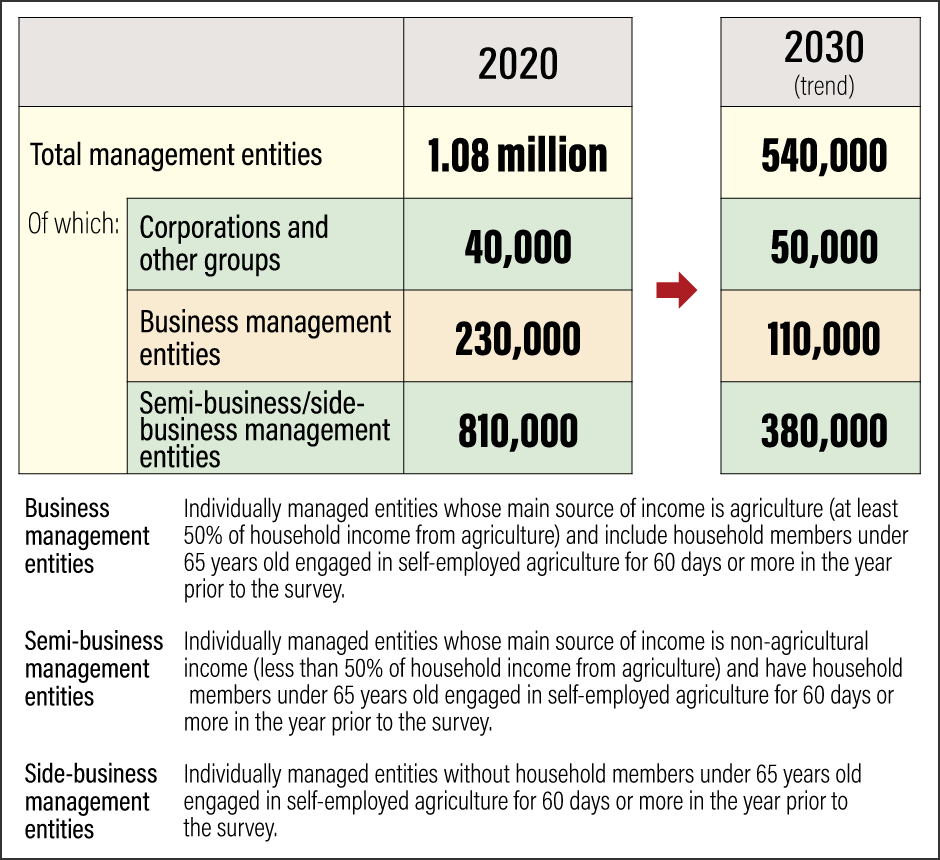 Provisional calculations by MAFF based on the Census of Agriculture and Forestry, the Survey on Movement of Agricultural Structure, and various land area statistics
Figure 2. Decline in agricultural management entitiesThe current trend shows that agricultural management entities will decline without measures to address the situation. There is a risk that the number of management entities will fall to 540,000 and that around 30% of agricultural land will fall into disuse by 2030.
Mechanisms for establishing agriculture as a viable occupation are also essential in order to attract new personnel to the sector. Due to the deflationary economy that has prevailed in Japan for many years, the prices of agricultural produce have not risen, which continues to put pressure on the business operations of producers. As a result, a negative spiral has emerged where low profitability makes it difficult to secure young farmers, leading to increased abandoned farmland and stalled new investment.
Precisely because Japanese agriculture faces so many issues, including declining workforce and stagnating productivity, the current basic plan examines the present situation in finer detail and pursues new initiatives.
One of the remarkable measures is the Act on the Promotion of Smart Agricultural Technology Utilization to Improve Agricultural Productivity, which was enacted in conjunction with the amendment of the Basic Act. Prescribing in law the promotion of agriculture using advanced technology, this Act is positioned as a key pillar in the establishment of sustainable agricultural systems. Based on the amended Basic Act, the new basic plan includes a commitment to “intensively promote the structural transformation of agriculture during the initial five-year period,” and smart agriculture is expected to support these efforts.
Environmental problems cannot be avoided
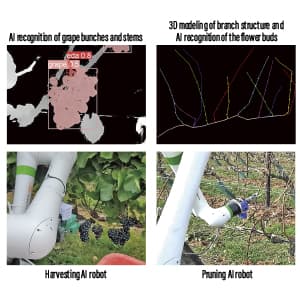
Smart agriculture involves the use of diverse information and robot technologies. Currently, commercialized technologies include GPS automated steering systems for precision farming, drones for pesticide spraying and growth status monitoring, soil sensors for water and nutrition management, and AI-based systems for diagnosing pests and diseases. It is expected that the effects of these technologies will include reducing the time required for tasks, alleviating workloads, increasing operational accuracy, reducing production costs, and stabilizing quality. As a result of postwar agricultural land reforms, Japanese agriculture was composed of a large number of farmers farming fields of around one hectare. But it gradually became impossible to make a living from agriculture at that scale, and agricultural land progressively became concentrated in the hands of large-scale business operations. This scale expansion has accelerated in recent years (Figure 3). This is likely due to the adoption of the smart agricultural techniques, supported by information technology, which enables more efficient farmland management and realizes further economies of scale.
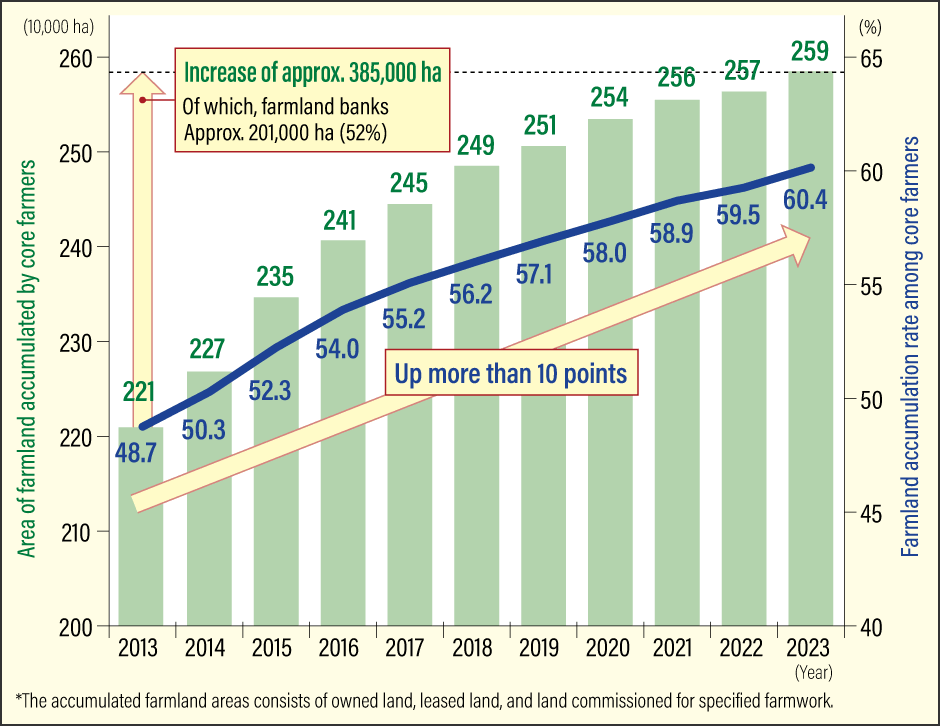 Research by the Agricultural Land Policy Planning Division, Management Improvement Bureau, MAFF
Figure 3. Trends in the farmland accumulation rateSecuring agricultural land and making effective use of it are necessary in order to maintain domestic agricultural production. Due to conversion to residential land and abandonment, the total farmland area has decreased by approximately 1.79 million hectares since 1961. On the other hand, efforts to consolidate farmland have proven effective, with an accumulation rate of 60.4%. The accumulation of farmland is essential in order to increase both productivity and profitability.
In Japan, the population declines, the domestic market is contracting, but on the other hand, overseas markets are expanding, so the basic plan also identifies a need to strengthen “earning power in overseas markets” by increasing exports. Smart agriculture is of crucial significance in this context, too. Quality control using precision agricultural technologies and data-driven production management are effective in ensuring a stable supply of high-quality, internationally competitive agricultural products. High profitability in agriculture will likely help to encourage younger generations to enter the sector.
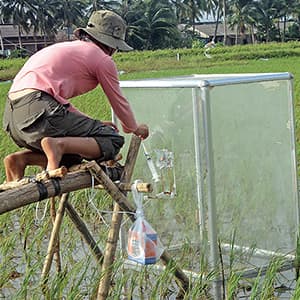
The establishment of “environmentally harmonized food systems” has also been added to the recently amended Basic Act as a new basic principle. For example, rice paddies emit a large volume of methane, which has a greenhouse effect approximately 25 times higher than CO2. While rice paddies have multiple environmentally positive functions, such as preventing floods and conserving biodiversity, they also have an impact on the global environment, so resolving environmental problems in the agricultural sector is a challenge we cannot avoid. To address environmental impacts, in 2021, the Ministry of Agriculture, Forestry and Fisheries (MAFF) formulated the Strategy for Sustainable Food Systems, MIDORI, aiming to achieve both productivity improvements and sustainability in food, agriculture, forestry and fisheries through innovation. MAFF’s goals by 2050 include:
- Zero CO2 emissions from fossil fuel combustion in agriculture, forestry and fisheries
- 50% reduction in risk-weighted use of chemical pesticides
- 30% reduction in chemical fertilizer use
- Increase in organic farming to 1 million hectares (equivalent to 25% of farmland)
In total, the strategy sets out 14 goals, requiring innovative approaches beyond conventional agriculture.
This principle runs through the amended Basic Act, with smart agriculture playing a crucial role. For example, using soil sensors and drones to monitor growth status will make it possible to ensure the optimum input of fertilizer and pesticides, thereby preventing the overuse that has occurred until now. There are a number of challenges involved in popularizing smart agriculture, including the large initial investment required, the need to master the technology, and the development of communications networks. However, various support measures are planned to promote its adoption.
Japanese agriculture is expected to ensure a stable food supply, but its survival is threatened by significant social changes. Rebuilding a sustainable food system that ensures everyone has access to a stable, healthy diet requires collaboration among producers, consumers, the government, and businesses. Agriculture now faces a major turning point in the effort to achieve this.