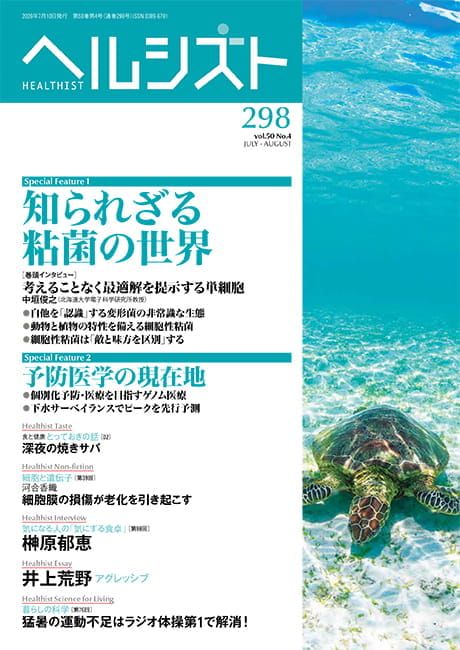

The yellow, jelly-like bodies that spread over fallen trees and humus are plasmodial slime molds (myxomycetes). These unicellular organisms with neither a brain nor a nervous system solve mazes through the shortest path, forming networks that closely resemble the Kanto region’s rail network. Professor Toshiyuki Nakagaki of Hokkaido University won two Ig Nobel Prizes after demonstrating this behavior in experiments, and is also the author of Kashikoi Tansaibō: Nenkin [Slime Molds: Smart Single-Celled Organisms], a picture book for children that illustrates the wonder of these organisms. Plasmodial slime molds do not “think.” However, the accumulation of local rules produces the optimal solution. This phenomenon leads to the fundamental question of what intelligence actually is.
Special Feature 1 – The Hidden World of Slime Molds Single cells that find the optimal solution without thinking
composition by Rie Iizuka

Toshiyuki Nakagaki
Professor, Research Institute for Electronic Science, Hokkaido University
In 1989, he successfully completed the master’s program at Hokkaido University’s Graduate School of Pharmaceutical Sciences. After working for a pharmaceutical company, he entered the doctoral program at Nagoya University’s Graduate School of Human Informatics and obtained a Ph.D. in 1997. He then worked at RIKEN before taking up the post of associate professor at Hokkaido University in 2000. In 2010, he was appointed professor at Future University Hakodate, subsequently becoming professor at Hokkaido University’s Research Institute for Electronic Science in 2013. Between 2017 and 2021, he served as the institute’s director. His specialty is physical ethology. He also concurrently serves as a director of Future University Hakodate and fellow at Chubu University. He was awarded Ig Nobel Prizes in 2008 and 2010.
When you walk through a park with a lot of trees, you may see a bright yellow, jelly-like substance spreading over fallen trees and decomposing fallen leaves. It is a little sticky to the touch and has a rather mysterious presence. This is a slime mold called Physarum polycephalum, which I am cultivating in my laboratory.
Two types of slime mold: plasmodial and cellular
Although you might have heard the term “slime mold,” few people know exactly what it is.
The five-kingdom classification system divides organisms into five categories (kingdoms)—Monera, Protista, Fungi, Plantae, and Animalia—based on their cellular structure and method of obtaining nutrients (Figure 1). Under this system, slime molds fall into the Protista kingdom. Protists are eukaryotes—that is, organisms made up of cells with a nucleus—that are neither animals, nor plants, nor fungi such as molds or mushrooms. Typical examples are single-celled organisms like paramecia, amoebae, and Euglena, but multicellular organisms such as wakame seaweed and kelp also fall into this group.
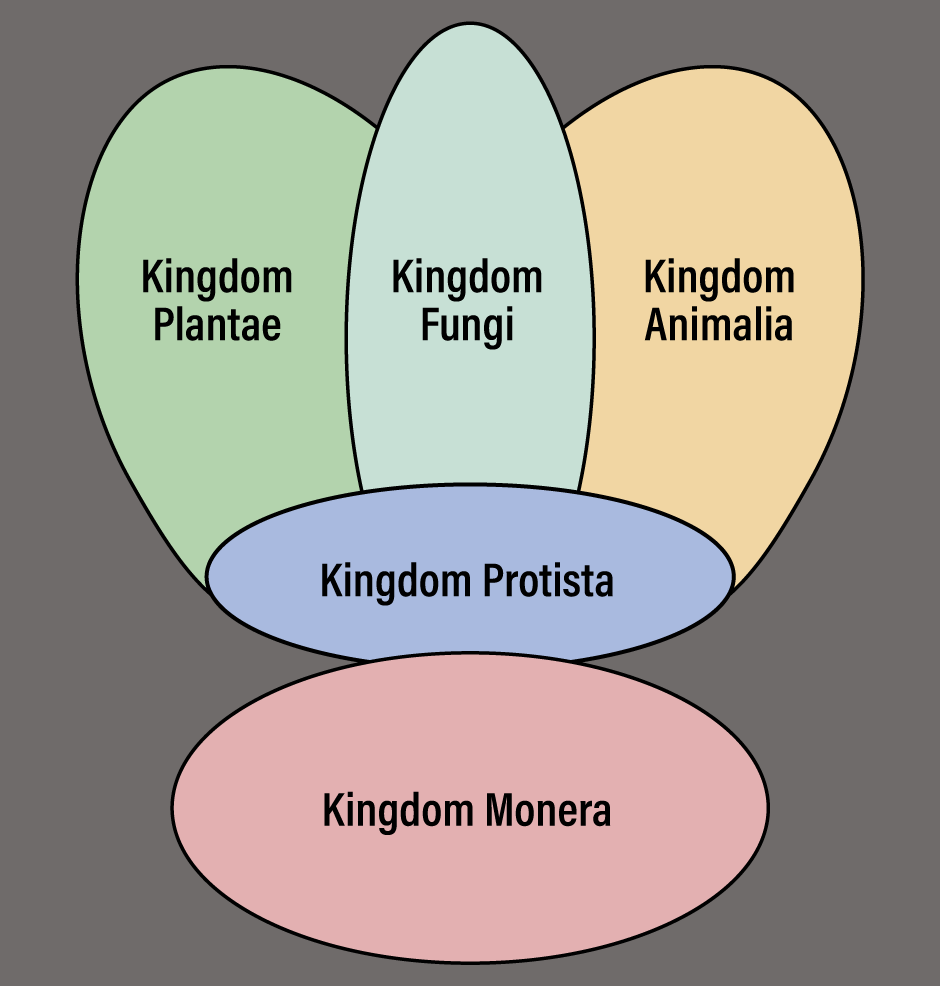
Figure 1. The five-kingdom classification systemThis system divides organisms into five kingdoms: Monera, Protista, Fungi, Plantae, and Animalia. Slime molds belong to the kingdom Protista. In recent years, genetic analysis has revealed that this group is even more diverse than previously thought.
Thanks to dramatic advances in genetic analysis technology in recent years, the sheer breadth of genetic diversity among protists has begun to become apparent. As research progresses, their classification is likely to be refined further, but it would be fair to say that slime molds are among the best-studied protists.
Many slime molds live in the soil or in the humus layer consisting of fallen leaves and the like that have built up on the forest floor. Broadly speaking, slime molds are divided into two categories: plasmodial, or true slime molds, and cellular slime molds. The biggest difference between plasmodial slime molds (also known as myxomycetes) and cellular slime molds is that the cells of the former fuse together, while those of the latter aggregate.
Plasmodial slime molds begin life as small amoeboid cells that sprout from spores. Rather than undergoing cell division, the cytoplasm simply expands to form a plasmodium. The nuclei quickly multiply, but it remains a single cell. When one plasmodium meets another of the same species, they fuse into one; if the conditions are right, they can grow to several dozen centimeters across or even more than a meter.
Plasmodia move by making their cytoplasm contract and expand inside tubes within their bodies. Using actin and myosin—two proteins also found in our own muscles—to expand and contract, they repeat this reciprocal motion in a very regular cycle, enabling the huge single cell to move. The fact that fluctuations in calcium concentration control this cycle is very similar to the mechanism that causes heart cells to pulsate.
Cellular slime molds, on the other hand, usually exist as individual single-celled amoebae, but when nutrients become scarce, they emit a signaling substance called cyclic AMP (cAMP) that summons others of their kind to form a multicellular mass consisting of tens of thousands of cells. Rather than merging, the cells remain separate, but move around as a mass and ultimately form a mushroom-like fruiting body that releases spores. Cellular slime molds also use the proteins actin and myosin to enable the individual cells to move, but they do not form huge single-celled bodies like plasmodial slime molds.
Ultimately connecting two feeding grounds by the shortest path
For many years, my research has focused on a plasmodial slime mold called Physarum polycephalum. I cultivate it in my laboratory and observe how it changes day by day. Some people feel that the plasmodium has a refreshing, citrus-like scent, while others say it smells like old tatami mats.
In 2008 and 2010, I won the Ig Nobel Prize—a parody of the Nobel Prize—for my research on this plasmodial slime mold.
It was an experiment using a maze that led to the first award. In this experiment, we placed a roughly 4-cm square of plasmodial slime mold over the whole maze, so that it spread through all the paths. In other words, this single plasmodial slime mold covered the entire maze. Next, we placed food in just two locations. When we did so, the first thing the plasmodial slime mold did was to immediately withdraw from dead-end paths where there was no food. Even on paths that were not dead ends, if they did not readily lead to the food, the tubes that the plasmodium had extended progressively became thinner and ultimately were severed. The plasmodial slime mold produced tubes along every route leading to the two feeding grounds, but at the next stage, it progressively withdrew from the longer routes and ultimately connected the two feeding grounds by the shortest path.
We carried out the experiment repeatedly, and in around half of the trials, the results were very close to the shortest route. Through our observations of the experiment, we discovered a rule governing the extension of the tubes: if there was a lot of protoplasm, the tubes became thicker, but if there was only a little, they became thinner and ultimately were severed. From the perspective of the plasmodial slime mold, producing tubes that are as thick and short as possible helps to minimize its cost, because it maximizes communication efficiency within the body while maintaining a single organism. Accordingly, the more protoplasm flows toward the location of the food, the thicker the tubes become, while routes with a low flow rate are naturally eliminated. In other words, a globally optimal solution emerged spontaneously from the accumulation of local rules. This observation later led to the formulation of a mathematical model based on the rule that the thickness of tubes changes according to the flow rate within them (the slime mold algorithm).
In a 2000 paper, I focused specifically on finding the shortest distance through a maze. I believe it attracted attention partly because mazes are widely recognized as a standard test of intelligence, but in the experiment that formed the basis of the paper, we observed various behaviors displayed by the plasmodial slime mold. Depending on the amount of food available, it did not always take the shortest path; instead, it sometimes chose longer routes, multiple routes, or even split into two.
After these findings, the next thing we published was the relationship between slime mold networks and the Kanto transport network. Since the slime mold could find the shortest path through a maze, we wondered what would happen if we had it create a transportation network. It was this paper that won my second Ig Nobel Prize.
In the experiment, we drew a map of the Kanto region on a 30-cm square agar plate and then placed food at points corresponding to major cities. We shone light—to which plasmodial slime molds have an aversion—on areas representing obstacles such as mountainous terrain, rivers, and the sea. After we placed the plasmodial slime mold at a point equivalent to Tokyo Station and began our observation, the slime mold formed a network that efficiently connected the food at the points corresponding to each city. Astonishingly, this network closely resembled the actual JR rail network in the Kanto region (Figure 2). Upon seeing the results, my reaction was not that the plasmodial slime mold was amazing, but rather that it was remarkable how closely the transport network resembled it. Plasmodial slime molds were able to find the optimal solution simply by searching for food, but the transport networks designed by humans are bound to reflect considerations such as political patronage and power relationships. I was impressed by the fact that, despite this, the Kanto region rail network compares surprisingly well to the algorithm of plasmodial slime molds.
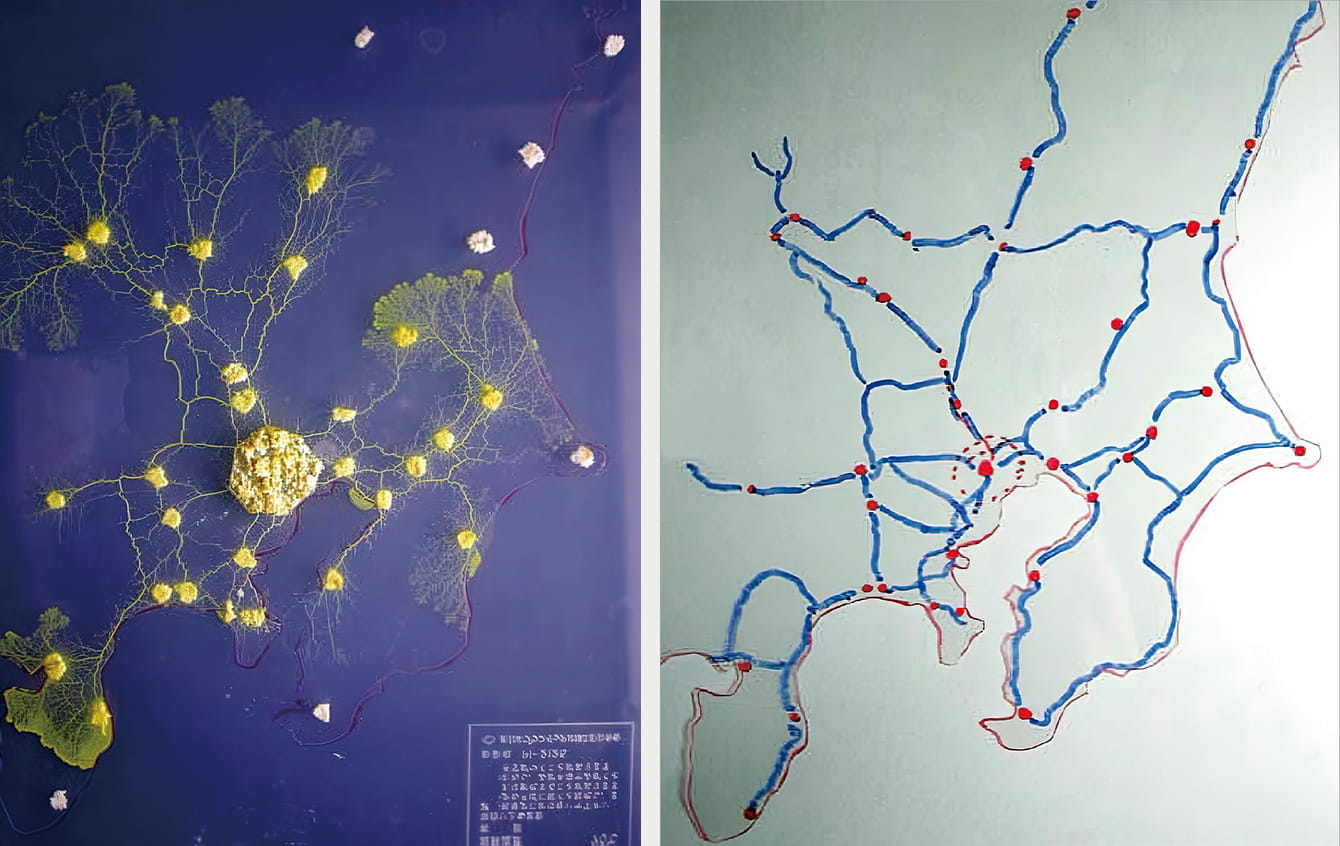 (Images courtesy of Associate Professor Seiji Takagi, Future University Hakodate)
Figure 2. The network formed by plasmodial slime mold and the actual JR rail network in the Kanto regionThe network created by the plasmodial slime mold in the experiment (left) and the actual JR rail network in the Kanto region (right). They demonstrate a high degree of alignment in terms of economy, redundancy, and efficiency.
What this experiment demonstrated was that the plasmodial slime mold naturally achieved three objectives simultaneously: not only economy by connecting locations as directly as possible, but also redundancy through the presence of alternative routes (remaining connected even when failures occur), and overall network efficiency. The plasmodial slime mold achieved a good balance between the three properties that are desirable in a rail network as infrastructure.
We have also made progress in applying this plasmodial slime mold algorithm to computer simulations. Once we wrote out the simple local rule as an equation—that tubes with a high flow rate are strengthened—we were able to derive the optimum network tailored to city scale and budgetary constraints. This has been adopted in practical applied research such as optimizing power grids and evacuation routes.
Another highly interesting behavior demonstrated by plasmodial slime molds is their ability to “remember” time.
We placed a plasmodial slime mold in a channel-like trough and exposed it to a comfortable environment with a temperature of 25°C and humidity of 90%. When we suddenly reduced the temperature and humidity an hour later, it stopped moving, and then began moving again when we returned the conditions to the original state 10 minutes later. We repeated this three times, and then did not change the environment for the next hour. However, in about half of the 100 trials, the plasmodial slime mold stopped moving of its own accord after an hour, as though it anticipated that it was time for the change to occur (Figure 3). Even though there was no external stimulus, the plasmodial slime mold behaved as though the pattern of environmental change after an hour had been imprinted in its body.
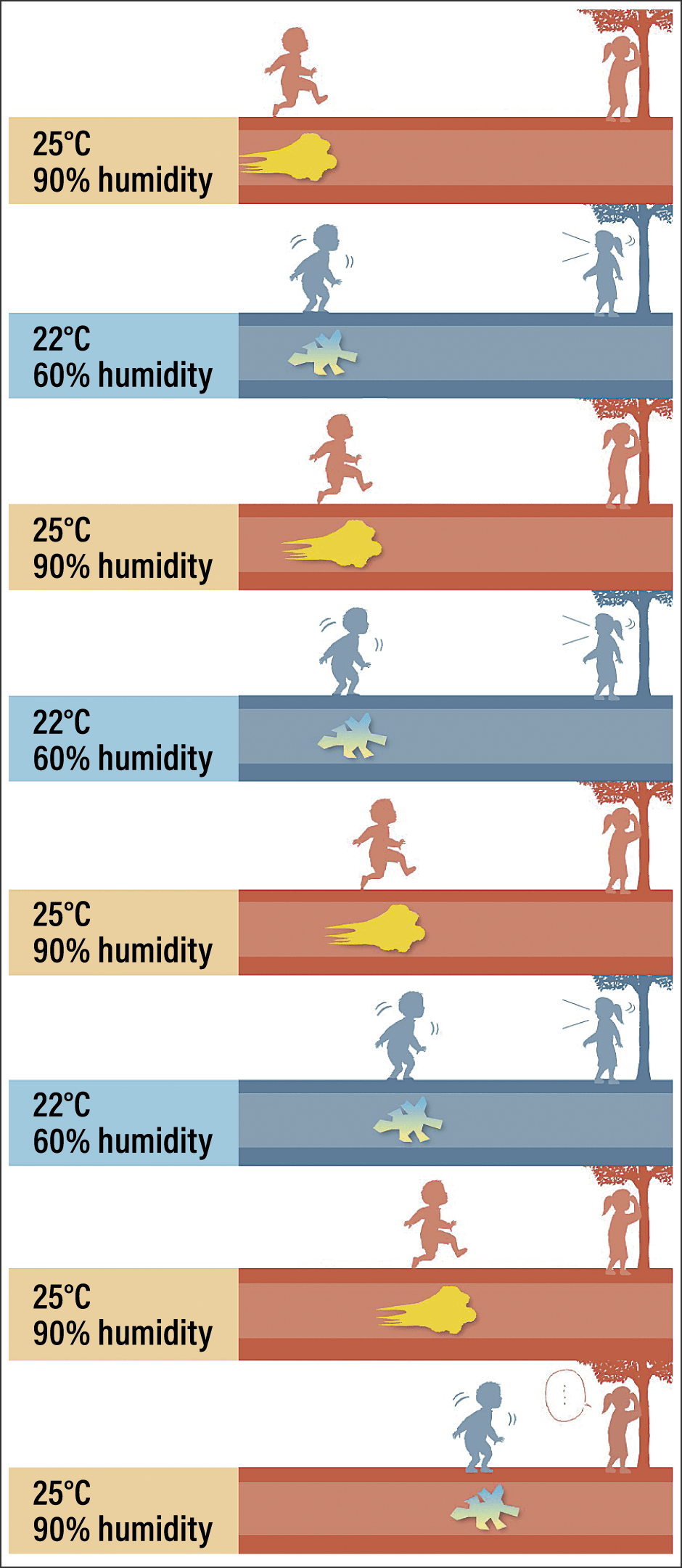 (Illustration by Toshiyuki Saito)
Figure 3. Plasmodial slime molds that remember timeThe researchers switched between a comfortable environment and an uncomfortable one at one-hour intervals, repeating the cycle three times. Although they then did not change the environment during the fourth cycle, the plasmodial slime mold stopped moving of its own accord after an hour in around half of the cases. This experiment shows that unicellular organisms without a brain can retain temporal patterns.
This series of experiments involving slime molds might make it seem as though slime molds have some kind of intelligence, despite not having a nervous system. However, this is no more than primitive intelligence, driven almost entirely by reflexes rather than anything resembling language or intention.
Result of simply repeating local rules
The approach espoused by U.S. scholar Herbert A. Simon, who won the Nobel Memorial Prize in Economics, provides a useful point of reference when thinking about what intelligence actually is. He advocated the concept of bounded rationality in research into corporate decision-making. This holds that humans are not rational entities with full information and unlimited computational ability, but rather act while making decisions that are satisfactory to some extent, based on limited information and capabilities. If we interpret slime mold behavior using Simon’s approach, it would be fair to say that the complex behavior demonstrated by slime molds ultimately does no more than reflect the complexity of their environment.
The slime mold’s ability to derive the shortest path is the result of simply repeating a local rule, namely that it makes tubes with a high flow rate thicker. This is similar to an approach called heuristics, which derives reasonable answers from empirical rules, rather than rigorous calculations. It is impossible to find the optimal solution to a network by evaluating every possible combination. If there are three options for a single intersection, then two intersections yield nine options (3×3), increasing to around 60,000 options for 10 intersections and around 3.5 billion options for 20 intersections. Thus, the calculations required increase with each additional intersection. If there are 200 intersections, it would be utterly impossible to complete the calculations, even if you left a supercomputer running continuously.
Car navigation systems employ a technique called Dijkstra’s algorithm to stratify maps and quickly produce an approximate solution. A slime mold’s “calculations” differ from this as well. It neither calculates all the combinations nor stratifies the map, it simply repeats local rules to quickly produce an answer that is sufficiently workable. I think it is actually similar to the intuitive overview that humans have when they take a quick look at a map and get a general sense of which way to go. Even when solving mazes and forming rail networks, slime molds are not thinking. However, this behavior still produces the optimal solution. I feel it is precisely this gap that is the most interesting aspect of slime mold research.
Cells contain the prototype of intelligence
Throughout my slime mold research, I have continually pursued the fundamental question of what intelligence actually is. I have now come to the idea that cells contain the prototype of intelligence. Underlying my research is the question of what evolutionary path led to the emergence of intelligence, from the primitive kind found among unicellular organisms through to the advanced form in humans. I want to gain a systematic understanding of this evolutionary path.
More recently, I established a new academic field called ethological dynamics in diorama environments, in partnership with scholars including Professor Takuji Ishikawa of Tohoku University. In 2021, our work was selected for a Grant-in-Aid for Transformative Research Areas. Our research involves placing slime molds and other protists in complex environments similar to those found in nature, in an effort to observe how they process information and to formulate models of their behavior.
In biological behavior research, there is a concept called taxis. This is the most fundamental reaction to a stimulus, in terms of whether an organism is attracted to or repelled by it. In the case of slime molds, the stimuli they like are food and specific chemical substances, while those they dislike are light, dryness, and toxic chemical substances.
In ethological dynamics in diorama environments, we start with the simplest situation, namely one stimulus that the organism likes and one that it dislikes. Next, we make the environment more complex in stages, examining which stimulus the organism moves toward if there are two stimuli that it likes; what the organism does if stimuli that it likes and dislikes are present at the same time; and whether the organism can move predictively if stimuli disappear and reappear at set times. Thus, by gradually making the laboratory environment resemble the outdoors more closely, we are trying to uncover the fundamentals of how organisms respond to complex situations. How is intelligent information processing realized through the movement of the substances that make up cells? We still do not know the answer to this question. Even so, I want to continue exploring the prototype of intelligence, using the clues provided by slime molds and other protists.