Aquaponics is a closed recirculating food production system that connects fish aquaculture and hydroponic cultivation in a single flow of water, using nitrifying bacteria to turn fish excreta into plant nutrients, while discharging hardly any effluent. As it uses no agrochemicals or antibiotics and prevents the entry of pathogens and parasites, it addresses the issues faced by onshore aquaculture. Scientists are also leveraging the physiological characteristics of marine fish that can grow even in low-salt environments similar to those of bodily fluids in order to explore new possibilities that combine marine fish with halophytes—plants that thrive in salty environments. However, a number of challenges to commercialization still remain, including the high cost of these systems and the lack of a framework for certification.
Special Feature 1 – Japan’s Evolving Aquaculture A closed recirculating food production system based on aquaculture and hydroponic cultivation
composition by Rie Iizuka
Masato Endo
Associate Professor, Department of Marine Biosciences, Tokyo University of Marine Science and Technology
In 2003, he completed the Doctoral Course of Aquatic Biosciences at the Graduate School of Fisheries Science, Tokyo University of Fisheries’ (now Tokyo University of Marine Science and Technology), and obtained a Ph.D. in fisheries science. After serving as a Postdoctoral (PD) Research Fellow under the Japan Society for the Promotion of Science Research Fellowship for Young Scientists, he became a research assistant in the Faculty of Marine Life Science at Tokyo University of Marine Science and Technology in 2004 and assistant professor in the same faculty in 2007. He has held his current post since 2019. His area of specialism is aquaculture science, with a particular focus on research and development aimed at achieving greater efficiency in recirculating aquaculture systems. In recent years, he has been examining aquaculture with material recycling, including aquaponics.
Aquaponics is a portmanteau word created from the terms aquaculture and hydroponics.
When aquaculture, or fish farming, is mentioned, the image of fish cages floating on the sea probably springs to mind for most people. In contrast, recirculating aquaculture is an onshore aquaculture system that repeatedly filters and sterilizes the water in the tanks so that it can be reused (Figure 1). By blocking the entry of pathogens and parasites and minimizing the effect of external environmental factors such as water temperature, it enables a stable supply of fish to be obtained. It is also regarded as environmentally advantageous because the water is purified and reused.
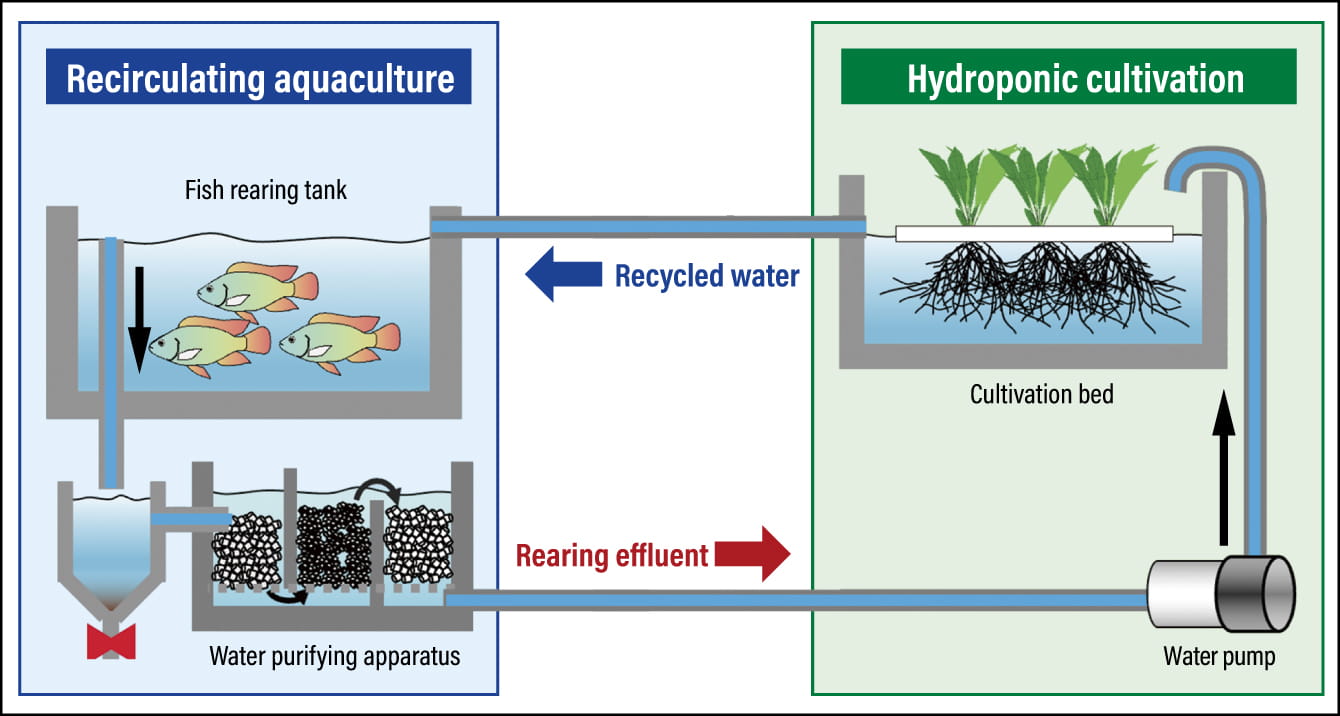
Figure 1. Water circulation in aquaponicsFeces and other solid matter in the effluent from the fish rearing tank settle and are removed. The effluent is then channeled into the water purifying apparatus, where microorganisms attached to the filter medium break the ammonia down into nitrates. With the aid of the water pump, water is channeled into the cultivation bed, where the plants absorb the nutrients. The recycled water returns to the rearing tank.
A mechanism for simultaneous fish farming and plant cultivation
However, it does pose a number of issues. As the water is reused, fish excreta build up in it. While feces and other solids can be removed using a filter, substances such as nitrogen and phosphorus dissolved in the water cannot be removed in this way. If this continues, the water becomes increasingly polluted, giving rise to the need to replace the water as necessary.
On the other hand, looking at it from a different perspective, the nitrogen and phosphorus dissolved in the water are actually nutrients for plants. The idea that this water could be used as a nutrient solution for hydroponic cultivation is the inspiration behind aquaponics. Vegetables absorb the nutrients as they grow, cleaning up the water before it is returned to the fish tank. In this mechanism, fish farming and plant cultivation are carried out using a single stream of water, allowing both to take place simultaneously.
This technology spread in inland areas of the U.S. during the 1970s. The catalyst was the simple desire to be able to eat fresh fish. The U.S. covers a large landmass, so fresh fish is not available in inland areas. On top of that, there are many arid regions, where water is also precious. Initially, recirculating aquaculture developed as a way to farm freshwater fish without using much water. Hydroponic cultivation of vegetables also flourished in inland areas, but here, too, the treatment of effluent from replacing the nutrient solution and other processes posed a problem. This led to the idea of aquaponics.
As a result, this mechanism produced unexpected advantages. Because fish are farmed in the same water, agrochemicals cannot be used for cultivating the plants. The technology became established as people appreciated the fact that it could produce safe vegetables without relying on agrochemicals and also generate hardly any effluent. The fish raised in the system were principally freshwater fish such as tilapia and catfish, which are relatively tolerant of deteriorating water quality.
Microorganisms play a key role in aquaponics systems. The most problematic component excreted by fish is ammonia. Highly toxic to fish, ammonia can poison and kill them if it builds up in their tank. Accordingly, microorganisms called nitrifying bacteria play an important role. Nitrifying bacteria oxidize ammonia in stages, turning it first into nitrite and then into less toxic nitrate. Nitrate and other such substances are comparatively harmless to fish, and at the same time serve as plant nutrients.
One highly interesting fact is that there is no need to add these microorganisms from elsewhere. These microorganisms are naturally supplied by the intestinal bacteria in fish feces, and in the case of freshwater fish, begin working just two weeks after the fish are introduced into the system. In other words, aquaponics creates an ecosystem consisting of three elements: the plants that absorb nutrients, the fish that produce nutrients, and the microorganisms that serve as a bridge between them. In a water tank, right before our eyes, we can observe the relationship between producers, consumers, and decomposers that we learn about in science lessons.
The dilemma of aquaculture using marine resources
Why is attention now focusing on onshore aquaculture in the first place?
Three things are essential for aquaculture: seed, feed, and water. We are facing issues with all three at the moment. Where fish cannot be raised artificially, farmers have to catch wild fry from the sea. Feed is often made from wild fish as raw material. In other words, while aquaculture serves as an alternative to marine resources, it nevertheless ends up using them.
There is also the problem that seawater becomes polluted. When fish are farmed in cages in the sea, their excreta flow back into the sea untreated. Although wild fish also excrete waste products in a similar way, they are distributed across a wider expanse of ocean, so the concentration in a single location does not become extremely high. However, as it becomes concentrated in aquaculture fish cages, nutrients reach excessive levels and can cause phenomena such as red tides in which plankton proliferate excessively and can harm marine life . In addition, fish excreta are deposited as solids on the seafloor where fish cages are located. The reality is that both cleaning up the seafloor and collecting the waste are difficult, so if the seafloor becomes too soiled, the only option is to move the fish cages to another location. One salmon farmer in Chile complained that they had to move their cages further and further offshore each time they became soiled. This increased the fuel and effort required to travel from their onshore base to the cages. It is difficult to see what is happening in the sea, but it could perhaps be likened to a situation on land that occurs in agriculture in developing countries, where the soil becomes depleted due to continuous cultivation of a crop, so farmers abandon their fields and change location. Although, in the case of the fisheries industry, eutrophication—where nutrients build up to excessive levels—is a problem at the opposite extreme, both types of food production involve an imbalance in nutrients.
In addition to overcoming these constraints, onshore aquaculture is expected to free people from the difficulty of coordinating fishery rights and allow fish to be farmed anywhere while controlling the environment. In Japan, too, a notification system for onshore aquaculture was introduced in 2023, and the field has at last begun to develop in earnest. However, once onshore, both water temperature and water quality must be entirely managed by human hand, which requires a considerable amount of energy. Even so, the biggest strength of onshore aquaculture is that fish can be farmed indoors in a more stable environment than the sea.
Reduced risk of disease and parasite introduction
Aquaponics is attracting attention because it offers solutions to a number of issues posed by onshore aquaculture.
First, hardly any of the water is discarded. Recirculating aquaculture itself greatly reduces the volume of water used, but does not eliminate the need to replace the water from time to time. In this respect, aquaponics can further reduce the volume of water used, because the water is purified by vegetable cultivation. The fact that hardly any effluent is generated also means that the environmental impact is small (Figure 2).
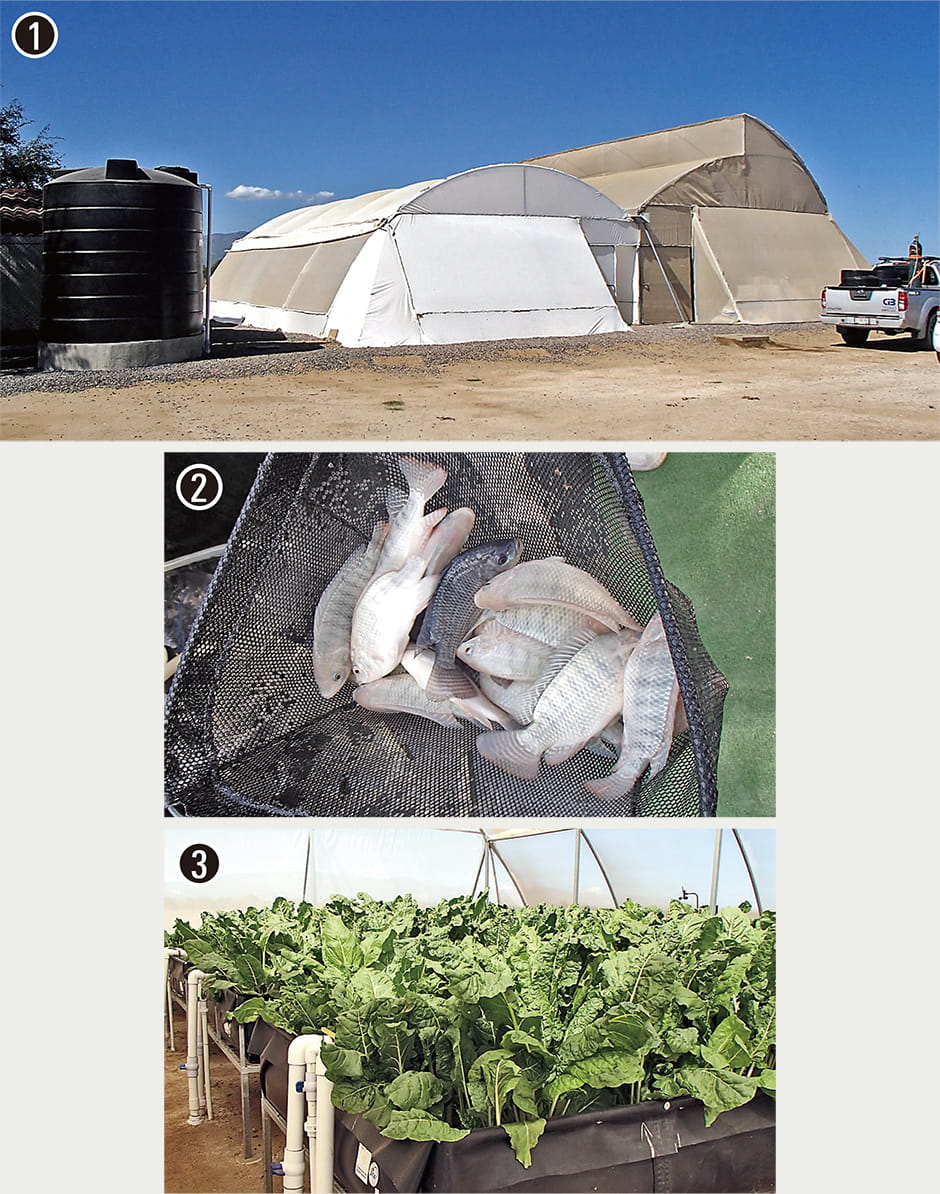
Figure 2. Experimental facility using aquaponicsAn experimental facility in a dry region of Mexico ❶. Tilapia are raised in an aquaculture facility ❷, and the recirculated water is used for hydroponic cultivation of Swiss chard ❸. The water is then used for irrigation of vegetables being grown outdoors. The aim is to use water more effectively while increasing productivity by incorporating aquaponics into the flow of water from irrigation to outdoor cultivation.
Another important point is that it does not rely on chemicals. As microorganisms and plants live together in a closed water system, using antibiotics or agrochemicals would kill off vital microorganisms, and the plants would also be affected by them, so chemicals cannot be used. A recirculating water tank that is not connected to the outside world keeps wild fish out, creating an environment where diseases and parasites are less likely to be introduced. As a result, the fish are farmed without relying on chemicals. This also gives consumers peace of mind.
The vegetables also develop a distinctive flavor. Chemical fertilizers promote plant growth but also increase the level of acrid-tasting components. However, fish-derived nutrients are low in such components, and I feel that this allows the vegetables’ natural flavor to come through more clearly.
The approach to aquaponics I have discussed so far has principally focused on combining freshwater fish with ordinary vegetables. However, the main fish involved in Japanese aquaculture are marine fish such as Japanese amberjack and red sea bream. Ordinary vegetables cannot be grown in seawater, creating a huge hurdle to overcome before aquaponics can be used with marine fish.
The physical mechanisms of fish hold the key. In fact, the bodily fluids of fish maintain a salinity of around 0.8%–0.9%, which is about the same as that of humans. On the other hand, the salinity of seawater is about 3.4%. Marine fish are constantly expelling salt that enters their bodies back into the surrounding water, and use up a great deal of energy in maintaining their hydration level. Reducing the salinity of water to a level close to that of their bodily fluids would therefore lower the amount of energy required for them to grow. In fact, Malabar grouper, a species of grouper farmed in Okinawa, grows well at a salinity level about one-quarter that of seawater. Among aquaculture-related researchers, it is a well-known fact that marine fish can actually do well in water that is not highly saline.
If a salinity level equivalent to seawater is not essential in fish farming, the range of plants that can be grown in aquaponics might also expand. However, as it is currently difficult to develop a device capable of selectively removing salt from water, reducing salinity as far as possible and then selecting plants that grow well in that environment for cultivation would appear to be a more realistic approach. While the number of salt-resistant crops is limited, we are currently examining what kinds of crops grow at what salinity levels and what adjustments to the nutrient balance will allow both fish and vegetables to grow well, testing these combinations one by one (Figure 3).
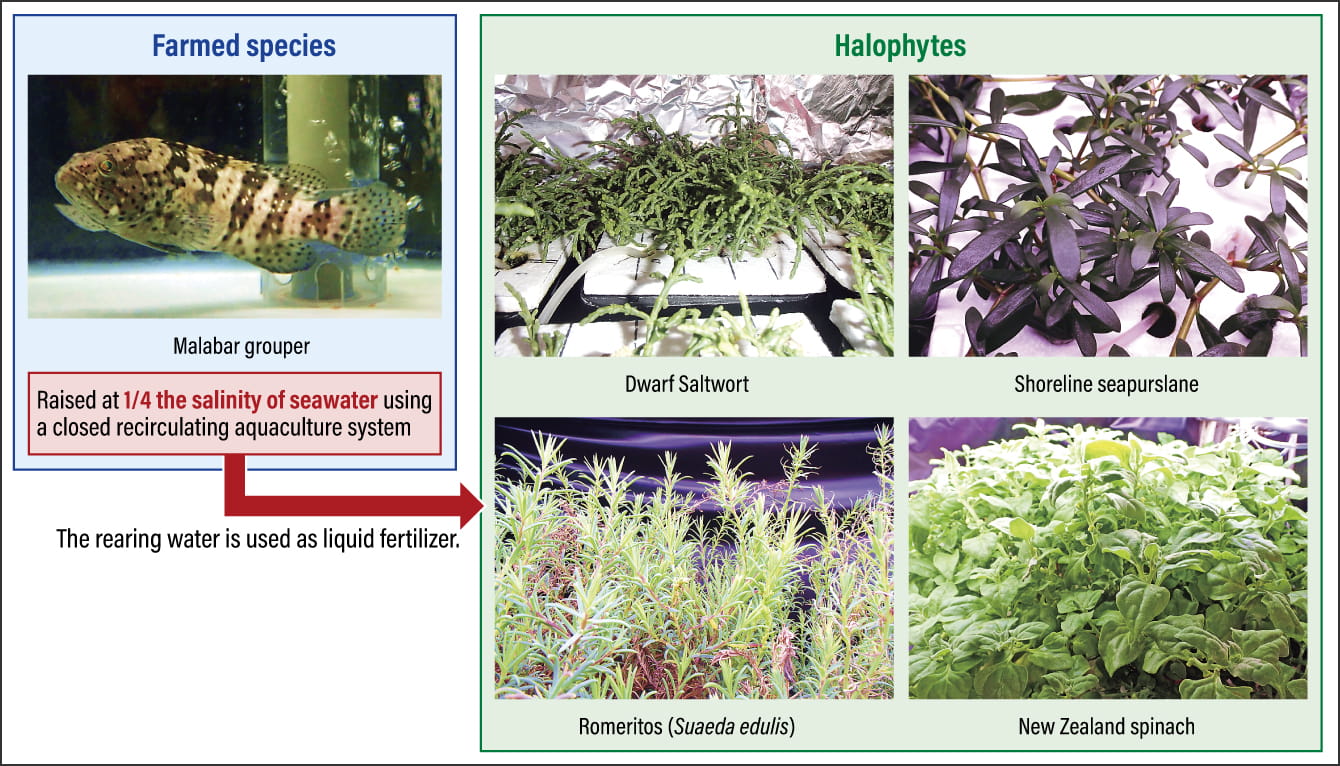
Figure 3. Cultivation of halophytes using effluent from recirculating aquaculture of Malabar grouperIn decoupled aquaponics, Malabar grouper are farmed at one-quarter the salinity of seawater, with their rearing effluent being used as liquid fertilizer to cultivate salt-resistant vegetables. The key will be whether halophytes can become widely accepted as food. Malabar grouper is a white fish with a delicate, sweet flavor. Dwarf Saltwort, shoreline seapurslane, and New Zealand spinach can also be found along the Japanese coast.
For example, there are vegetables that can grow in seawater and are naturally salty, such as Dwarf Saltwort (a type of glasswort commercially available in Japan under the name sea asparagus), which can grow even at high salinity. It is salty enough that it does not even need dressing. While it may not yet be commonplace in Japan, many vegetables from other countries have been introduced and become firmly established here, and new possibilities for food are also emerging.
Aquaponics is gradually becoming more widespread even in Japan. Pioneering companies in Kanagawa and Niigata prefectures have been the driving force behind these efforts. Today, more than 10 companies are reportedly involved in the field nationwide. Most of them, however, focus on vegetable production and sales rather than fish. This is because the excreta from a single fish is enough to grow a substantial yield of vegetables. For aquaponic production to become established as a market, it will be necessary to increase the volume of both fish and vegetables shipped to market.
Higher costs for onshore aquaculture
One issue at present is how to convey the value of the vegetables produced using aquaponics. Aquaponics uses no agrochemicals and has a low environmental impact, but because no soil is used for hydroponic cultivation, Japan’s organic JAS certification essentially does not apply to such products, and there is no framework for their certification. Accordingly, efforts to create a certification system specifically for aquaponics are also underway. This involves a process of trial and error to ensure that as many people as possible can perceive the value in the phrase “grown using aquaponics.”
In addition, onshore aquaculture currently entails higher costs than marine aquaculture. As both water temperature management and water treatment require energy, profitable operations require fish that can be sold at a relatively high price. That is why the fish species chosen are those with high added value, such as sturgeon, from which caviar can be obtained, and willow gudgeon, a premium fish native to Lake Biwa. For similar reasons, it is probably realistic to expect that aquaponics will begin with fish that can be marketed as high-value food products, to ensure people recognize their value.
I believe there are still a number of challenges that ought to be overcome before aquaponics becomes prevalent as a food production technique. On the other hand, bringing fish farming from the sea to the land and integrating it with agriculture and other industries could open up opportunities for people who have hitherto had no connection to fisheries to get involved in fish farming. Although working in aquaculture may have seemed difficult in the past, I believe that integration with agriculture could create opportunities for supported employment for people with disabilities, making aquaculture a place for more than just economic activity.
In the first place, an aquaponics system that allows fish and vegetables to be cultivated together has the advantage of being able to be installed anywhere. The scale of the apparatus does not matter, so in the U.S., it has been installed in several hundred schools, where it is used as a teaching material for learning about social structure, covering everything from raising fish, the function of microorganisms, changes in water quality, and harvesting, right through to cooking and sale. There are also small kits for household use, so some people enjoy engaging in aquaponics as a hobby, growing lettuce on a water tank or growing ornamental flowers at home. Its broad reach across industry, education, and hobbies is one reason why aquaponics has spread across the globe.
Aquaponics is not simply one option for the aquaculture industry; the concept behind it could also help to promote a deeper understanding of aquaculture. I hope that it will become more widespread in Japan.