Coastal aquaculture is facing a triple whammy: the saturation of suitable areas, the frequent occurrence of the harmful algal blooms called red tides , and rising sea temperatures. As such, there is a pressing need to expand aquaculture into offshore areas. Submersible cages that evenly exchange air and seawater make it possible to achieve offshore aquaculture that can withstand even the high waves caused by typhoons. In coastal areas, semi-closed sea surface aquaculture systems that circulate deep seawater are an effective measure against red tides and parasites. Scientists also aim to create sustainable offshore areas that bring together energy, food, and ecosystem conservation by combining offshore wind power generation, integrated multi-trophic aquaculture (IMTA), and smart fisheries that leverage sensors and AI.
Special Feature 1 – Japan’s Evolving Aquaculture The future made possible by submersible cages and smart fisheries
text by Shiho Fujiki
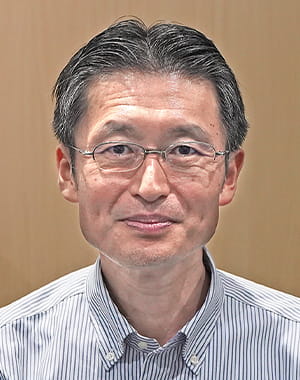
Daisuke Kitazawa
Professor, Institute of Industrial Science, the University of Tokyo
In 2002, he successfully completed a doctoral program at the Department of Environmental and Ocean Engineering, Graduate School of Engineering, the University of Tokyo, and was awarded a Ph.D. in engineering. He then joined the university’s Institute of Industrial Science as a lecturer, subsequently becoming an associate professor, and has held his current post since 2018. His areas of expertise are the use of marine resources for food and energy, and ecosystem conservation. After conducting research focused on assessing the impact of offshore structures on the surrounding environment, he began researching underwater feeding systems and fish cages for offshore aquaculture around 2007. He aims to achieve sustainable marine resource use through marine ecosystem engineering.
Aquaculture in Japan has mainly taken the form of coastal aquaculture using fish cages in calm coastal waters. Coastal aquaculture still remains a key part of the fisheries industry today for reasons of both safety and ease of operation, as the sites are located close to land, with little impact from waves. At the same time, a moderate current is required for fish and shellfish farming to avoid the deposition of excreta, but the recent occurrence of red tides and rising sea temperatures mean that the marine areas suited to aquaculture are growing smaller by the year. In addition to the nutrient burden imposed from the land, “self-pollution” can occur due to marine eutrophication when excreta build up, giving rise to phenomena such as red tides and marine oxygen depletion, which markedly reduce productivity. It is not rare for red tides—abnormal blooms of plankton—to destroy all the fish in a cage, resulting in immense losses.
Furthermore, rising sea temperatures due to climate change are adding insult to injury. “In the case of coho salmon farming in Miyagi Prefecture, the start of sea-surface farming is being delayed, while the harvesting season is beginning earlier in summer. Similar things may be happening in other marine areas as well.”
These concerns are voiced by Professor Daisuke Kitazawa, a marine ecosystem engineering expert from the University of Tokyo’s Institute of Industrial Science. Having started out in the field of naval architecture and ocean engineering research, he has undertaken research in such areas as numerical simulations of marine environments based on fluid dynamics. Currently devoting his energies to the development of aquaculture facilities, Kitazawa has been involved in research into next-generation fish cages inspired by the desire to expand the areas where aquaculture can be pursued in Japan.
Submersible cages that minimize the impact of high waves
Efforts to use engineering to solve these issues faced by coastal aquaculture produced two approaches: the submersible cage and the semi-closed sea surface aquaculture system (Figure 1).
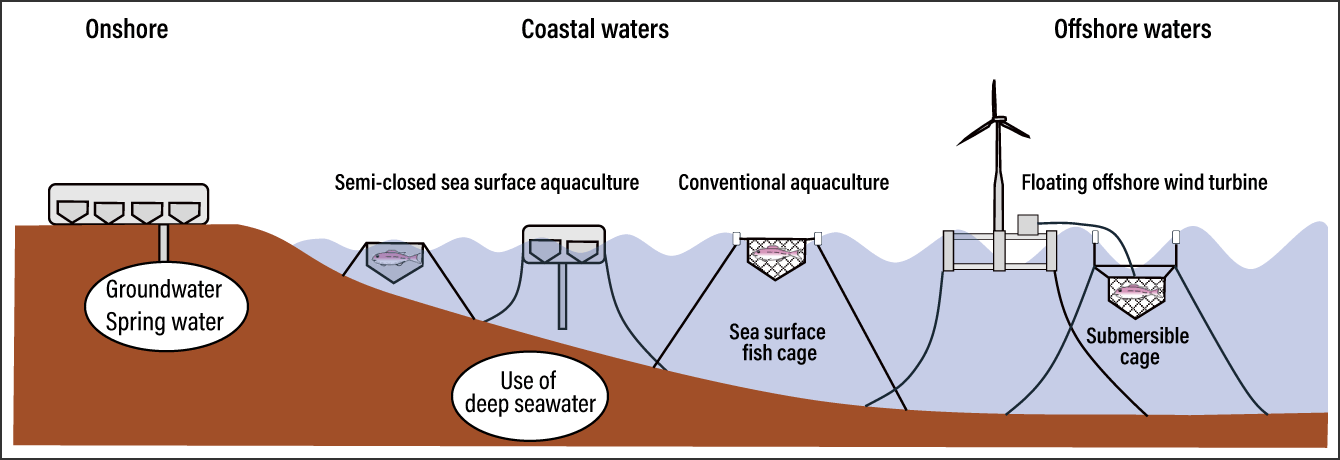
Figure 1. Schematic of aquaculture locations and systemsKitazawa and his team have developed a sheet-based semi-closed sea surface aquaculture system for conventional coastal aquaculture, and a submersible cage that can be combined with floating offshore wind turbines for aquaculture in offshore waters.
To start with, “I wanted to make it possible to engage in aquaculture offshore, as it had been limited to onshore and coastal areas,” Kitazawa says. However, simply moving the fish cages used in coastal aquaculture offshore would not be enough. As waves are higher offshore, the fish cages used in coastal aquaculture deform easily under the force of the waves. Given that existing fish cages could not withstand the harsh offshore environment, Kitazawa’s lab worked with a private company to devise a submersible cage that could be lowered below the sea surface, where it would be less exposed to the force of the waves concentrated near the sea surface.
Although this concept had been around a long time, there were technical barriers to its practical application. In other countries, fish cages made from impact-resistant high-density polyethylene pipes are commonly used, so the team aimed to give these cages the ability to submerge in order to use them offshore. The most common form of fish cage features netting hung from a large circular frame made from polyethylene pipe; even these can be raised and submerged by exchanging air and seawater inside the pipes. However, as polyethylene pipes bend easily, it was difficult to exchange air and seawater evenly.
“Other countries gave up on submerging conventional fish cages made from polyethylene pipe and instead went down the path of redesigning the fish cages themselves, substantially altering their shape for use offshore,” Kitazawa explains. “However, the cost involved was high, and this also raised the barriers to their popularization. While making as much use as possible of the fish cages used up to that point, we went through a process of trial and error in seeking to create a structure that could be raised and submerged reliably.”
What they developed was a large submersible cage with improved buoyancy and submersibility, which was achieved by partitioning the structure inside the ordinary polyethylene pipes in order to increase the efficiency of air and seawater exchange. They divided up the interior of the polyethylene pipe into several compartments, so that, when submerging the cage, they could introduce seawater into each compartment in stages from below and release air from above, thereby steadily replacing air with seawater. The research team has actually used the approach in submersible tuna farming cages with a diameter of 50 m and a depth of 23.5 m, in marine areas including Kashiwajima Island, Kochi Prefecture. “We have demonstrated that submerging the fish cage enables it to withstand high waves due to typhoons and the like,” Kitazawa says. His team developed this submersible cage based on the partition method in partnership with a private company and has even patented it. Introduction of these cages is progressing not only at Japanese aquaculture sites, but also in the Philippines and other countries.
There is another type of submersible cage system, called the hose system, in which the flow of air through a hose inside the pipe is controlled to steadily raise and submerge the cage. In collaboration with private companies, the research team developed an underwater feeding system along with a submersible cage using this hose system, and conducted field trials in Onagawa Bay, Miyagi Prefecture, where coho salmon are farmed (Figure 2). As coho salmon die if the seawater temperature remains at 21°C or more for prolonged periods, shipping needs to be completed by July if they are raised on the sea’s surface. However, the introduction of submersible cages makes it possible to farm them even at depths of 10–20 m, where the temperature of the seawater is lower. This means the production period can be extended through to mid-August or thereabouts, right before the start of the chum salmon fishing season. The team is also developing a variable-depth submersible cage that allows the depth to be altered at will; as part of these efforts, the researchers have improved the hose system and devised a way of adjusting the tension of the ropes used to moor the cage, enabling the buoyancy to be varied.
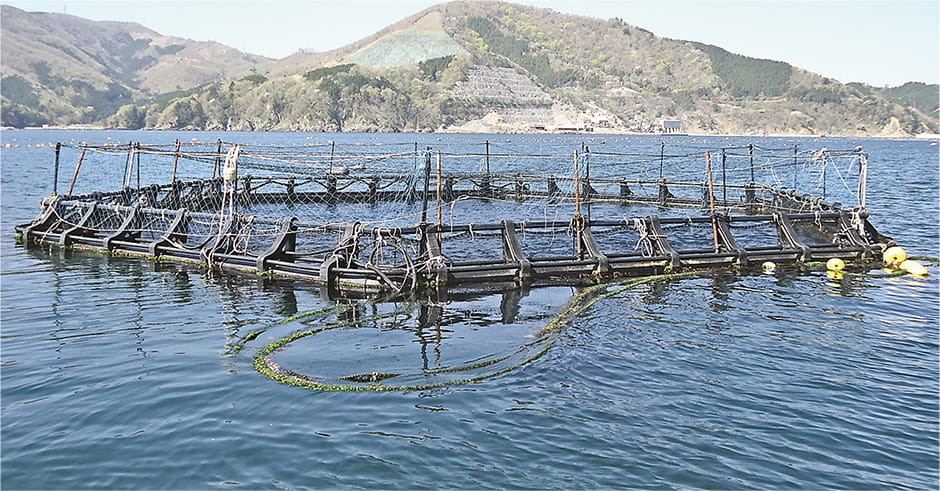
Figure 2. Submersible cageAir is pumped into and out of hoses inside high-density polyethylene pipes to raise and submerge the large cage reliably.
Another area to which Kitazawa and his team have been devoting their energies in recent years is the integration of submersible cages with offshore wind power generation (Figure 3). As offshore wind power generation is expected to become more prevalent going forward, the idea here is to combine aquaculture with electricity generation by installing fish cages near wind power generation facilities built offshore. “Although the development of submersible cages is progressing, systems for feeding and managing the cage and fish aren’t in place yet, so we’re wondering whether we could use floating offshore wind turbines as a platform for delivering compound feed to fish in the cages,” Kitazawa explains.
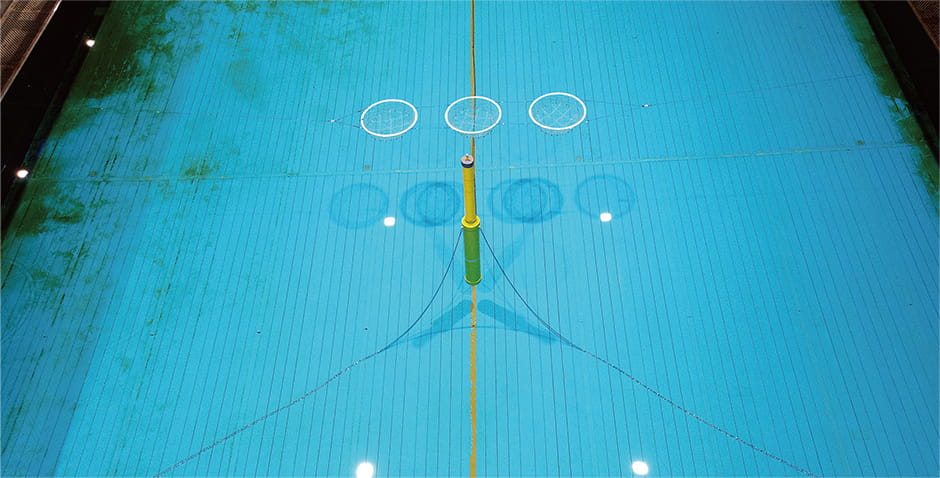
Figure 3. Integration with a floating offshore wind turbineIn a study aimed at farming fish in cages near floating offshore wind turbines, the team installed three fish cages beside a wind turbine in the center of a test pool (the photograph shows the wind turbine with its blades and other components removed), generated waves equivalent to those in actual marine areas, and measured changes in the movement of both the turbine and the fish cages.
The team has just embarked on basic research aimed at evaluating the safety of installing fish cages near wind turbines, including how the structures would affect each other. As such, there are still many issues to be addressed before field experiments can be conducted. Nevertheless, preliminary estimates suggest that revenue from fish sales could be more or less equivalent to that from wind power generation, depending on the conditions under which they are combined. Kitazawa therefore hopes that “since workers will already be traveling all the way offshore to maintain the turbines, the economic value generated by the area could more than double if they also supplied feed and managed the fish at the same time.”
Circulating seawater by pumping up deep water
For coastal aquaculture in areas with only weak currents, on the other hand, Kitazawa and his team have proposed a semi-closed sea surface aquaculture system that uses a sheet made of a material that is not easily penetrated by seawater, instead of conventional netting (Figure 4). Seawater flows freely in and out of conventional fish cages made from netting. While this has the advantage of allowing nature to clean up fish excreta, the drawback is that plankton and parasites and the like can also enter from the open sea. In contrast, the semi-closed sea surface aquaculture system the researchers have developed uses a sheet to cover the fish cage and separate the seawater inside from that outside (Figure 5). Deep water with a low concentration of plankton and parasites is pumped up into the fish cage and circulated while the fish are farmed there.
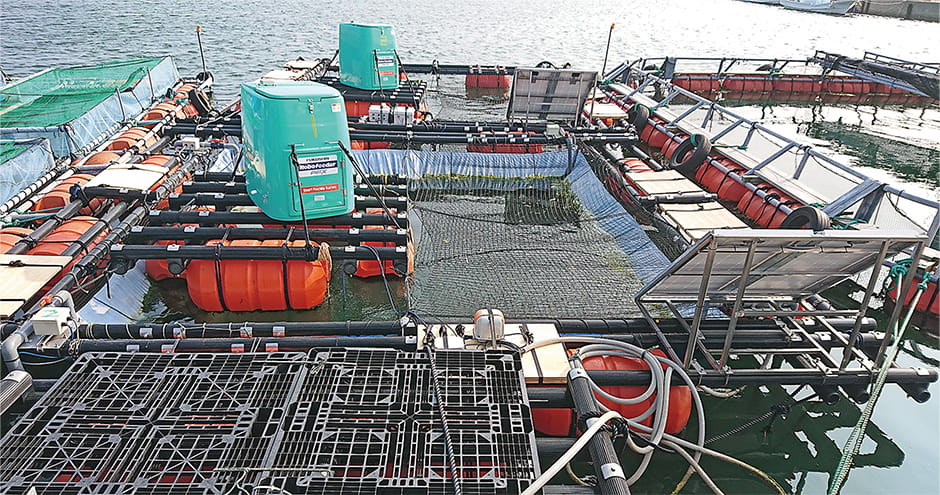
Figure 4. Semi-closed sea surface aquaculture systemThe researchers proposed a new idea in which a sheet made from a material that is not readily penetrated by seawater is used instead of conventional netting, and deep seawater with low concentrations of plankton and parasites is circulated for aquaculture. This was implemented under the JST-Mirai Program of the Japanese Science and Technology Agency as a full-scale R&D project entitled “Development of Next Generation Sustainable Aquaculture System” in the “Sustainable Society” mission area.
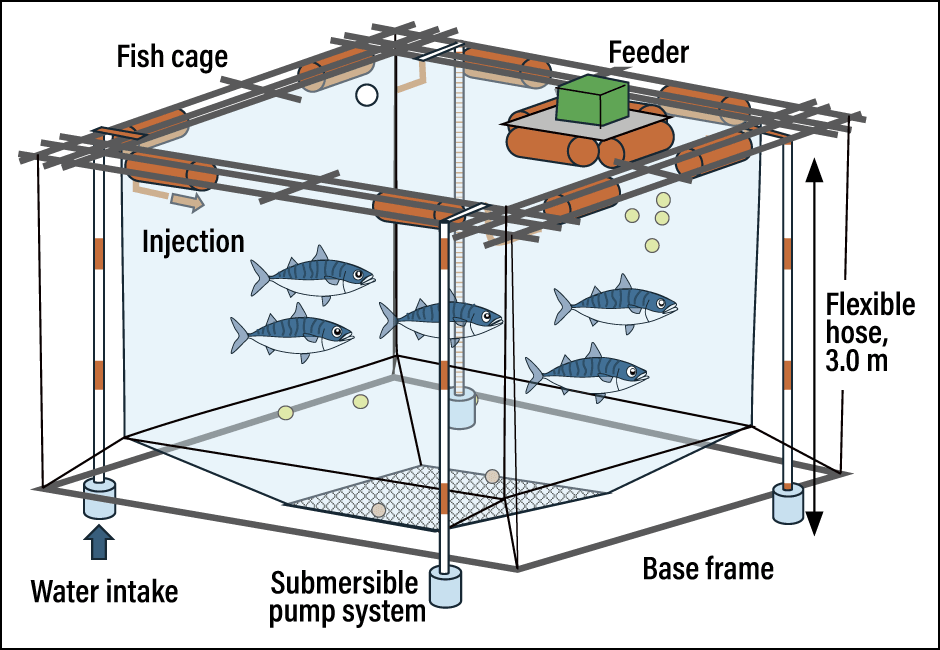
Figure 5. Schematic of a semi-closed sea surface aquaculture systemIn the field trial, the researchers placed a set number of mackerel in the fish cage and used underwater cameras to monitor fish behavior while measuring water quality parameters such as seawater temperature, salinity, and dissolved oxygen concentration, as well as wave height and flow rate.
“In Norway, they are considering this kind of technology to prevent parasites from entering and fish from escaping when farming salmon, but in Japan we have different needs in the form of measures to combat red tides and manage water temperature,” Kitazawa says. “Our intention was to temporarily avoid damage from red tides and the like and thereby increase productivity, while keeping costs down by adopting a simple sheet that can just be placed over existing fish cages.”
There is no need to keep the sheet closed all the time, so it can also just be placed over the fish cage in an emergency, such as when a red tide occurs. This semi-closed sea surface aquaculture system makes it possible to reduce the seawater temperature inside the fish cage even in summer. An experiment involving the rearing of mackerel at locations including Nakaminato Fishing Port in Ibaraki Prefecture demonstrated that fish growth actually improved.
Integrated multi-trophic aquaculture (IMTA)—an approach that combines environmental conservation with productivity by having other organisms absorb the excreta of farmed fish—can be seen as the extension of new aquaculture systems of this kind. In aquaculture, only around 30% of feed is used for fish growth, with the remainder released into the environment as excreta and the like. IMTA, which combines multiple organisms in aquaculture, therefore holds great potential for reducing this kind of self-pollution.
“By recycling excreta as a resource, rather than treating it as a waste product, we’ll be able to establish a sustainable aquaculture industry,” Kitazawa says. For example, in Norway, seaweed is being cultivated around aquaculture facilities to absorb fish excreta. Kitazawa’s laboratory has also begun experiments to promote the growth of sea cucumbers by cultivating them under coho salmon cages and feeding them on the excreta from the fish. Having analyzed the surrounding environment in detail, the researchers are using simulations to examine how the excreta disperses and where sea cucumbers and seaweed should be placed to absorb it most efficiently.
Wanting to enrich marine resources as a whole
From the perspective of marine ecosystem engineering, Kitazawa has made it his priority to reconcile marine resource development with ecosystem conservation. For example, a very large floating structure called a Mega-Float could be used for marine cities and the like, but it is essential to evaluate its impact on the surrounding environment in advance. In earlier research, to examine the environmental impact of a Mega-Float in Tokyo Bay, Kitazawa developed a coupled numerical model linking flow fields with ecosystems and projected changes in water quality due to organisms adhering to the underside of the Mega-Float.
“As the Mega-Float floats on the sea, one would expect its impact on flow fields to be less than that of reclaimed land, but the huge shadow it casts underneath could affect primary production and water quality,” he says.
Aside from offshore wind power, the sea offers various renewable energy resources, including wave power, tidal currents, ocean currents, ocean thermal energy, salinity gradient, and tidal power. Kitazawa is also moving forward with research into wave power generation, including the development of small boats that harvest wave energy, reduce their rolling motion, and increase their propulsion. Offshore aquaculture will necessitate regular boat trips to replenish feed and fuel. If electricity derived from wave power generation can be used to power boats traveling to and from offshore aquaculture sites, it might be possible to reduce operating costs and carbon dioxide emissions. “By increasing offshore wind power generation facilities, we might be able to create a natural ecosystem around them,” Kitazawa says. “I don’t just want to create aquaculture systems tailored to environmental changes and disasters; I want to enrich marine resources as a whole.”
Looking further ahead, Kitazawa envisions sustainable marine cities that integrate energy, food, and ecosystem conservation within a single sea area. Japan has developed a tradition of enriching ecosystems through moderate human intervention, as exemplified by the satoyama and satoumi models of sustainable land and marine management. At a time when the aging of workers and labor shortages in depopulated areas are becoming increasingly serious, implementing plans of this kind in offshore areas will require further efforts to make the fisheries and aquaculture industries smarter by tapping into sensors, robots, AI, and the like, while at the same time cultivating talent with expertise spanning engineering, fisheries science, and ecology.