Having pioneered fish farming trials using net cages in 1954, Kindai University’s Aquaculture Research Institute began research into full-cycle aquaculture of bluefin tuna in 1970. After 32 long years of research, it achieved the world’s first full-cycle aquaculture of bluefin tuna in 2002. In 2026, the institute also announced that it had achieved the world’s first full-cycle aquaculture of blackthroat seaperch, a highly prized deep-water fish, bringing the total number of fish species for which it had achieved full-cycle aquaculture to 30. However, environmental challenges remain, including eutrophication and the energy consumption of land-based aquaculture. The institute is at the forefront of aquaculture technology in Japan, conducting research into genetic improvement that combines selective breeding and genome editing to support integrated production from egg to table.
Special Feature 1 – Japan’s Evolving Aquaculture At the forefront of full-cycle aquaculture: Kindai University’s Aquaculture Research Institute
composition by Rie Iizuka
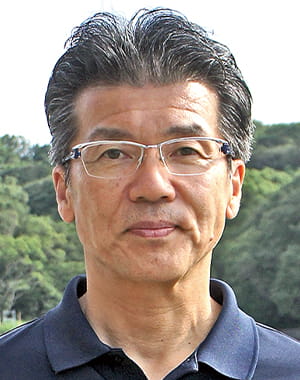
Keitaro Kato
Professor and General Director, Aquaculture Research Institute, Kindai University
He completed a master’s degree at Kindai University’s Graduate School of Agriculture in 1992. He joined the university’s Aquaculture Research Institute as a research assistant in 1993, becoming an associate professor there in 2006, and was subsequently appointed professor in 2014. He has served as head of the institute’s Shirahama and Toyama stations and was appointed General Director of the Aquaculture Research Institute in 2025. His work involves genetic improvement of marine fish, with a particular focus on red sea bream, along with the development of feed for fish farming, seed production techniques for Pacific bluefin tuna, and new aquaculture species such as blackthroat seaperch. He received the FY2021 Scientific Achievement Award in Fisheries Science from the Japanese Society of Fisheries Science.
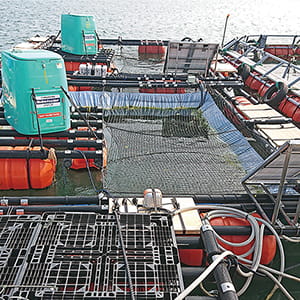
The first image that might spring to mind when you hear the word “aquaculture” is that of fish pens floating in the sea. This method is technically known as net cage aquaculture, and it was Kindai University’s Aquaculture Research Institute that first trialed it for commercial use back in 1954. Today, almost all marine fish aquaculture in Japan uses this method.
Aquaculture refers to the practice of raising fish, shellfish, seaweed, and other aquatic organisms under controlled conditions for harvest and sale. However, the methods used vary considerably depending on the species. Full-cycle aquaculture, which gained public attention through bluefin tuna farming, involves managing the entire life cycle: collecting eggs from wild-caught broodstock, raising the resulting offspring to maturity, and obtaining eggs from them to produce the next generation. Full-cycle aquaculture of red sea bream was established in the 1960s. Even today, however, a large proportion of farmed tuna and Japanese amberjack are raised from wild-caught juveniles in net cages until they reach market size (Table).
| Basis of classification | Type | Farming methods, locations, and key features | Representative species |
|---|---|---|---|
| Rearing method | Full-cycle aquaculture | Rearing hatchery-produced fish to maturity, collecting eggs from them, and rearing the next generation. | Bluefin tuna, red sea bream, white trevally |
| Capture-based aquaculture | Rearing wild-caught juveniles to market size. | Japanese amberjack, bluefin tuna, Manila clams | |
| Rearing environment | Marine aquaculture | Farming in coastal waters. Fish are commonly reared in net cages, while other methods are used for shellfish and seaweed. | Fish: Japanese amberjack, red sea bream, greater amberjack / Shellfish & seaweed: oysters, scallops, nori, wakame kelp |
| Inland aquaculture | Farming in freshwater or brackish-water environments, including rivers, lakes, and ponds. | Eels, sweetfish, rainbow trout | |
| Land-based aquaculture | Farming in tanks or other facilities on land, often with controlled water temperature and quality. Such systems can reduce exposure to weather and certain parasites. | Salmon, shrimp |
Aquaculture is grouped along two axes: rearing method and rearing environment.
Global aquaculture production exceeds that of capture fisheries
The stagnation of global capture fisheries production since the 1990s is likely one reason why aquaculture technology is attracting increasing attention worldwide. Aquaculture continues to expand, driven by the need to secure protein supplies for a growing global population and by rising fish consumption worldwide. Global aquaculture production has continued to rise since the 1990s and now exceeds capture fisheries production.
Growth in aquaculture production often brings Norwegian salmon to mind, but freshwater fish farmed in China have played a major role in this increase. Carp species such as grass carp and silver carp can be raised in relatively simple pond systems that make use of their different feeding habits. Grass carp feed mainly on grasses and aquatic plants, while silver carp feed mainly on phytoplankton, whose growth can be promoted by fertilizing the ponds. Although salmon production in Norway has also increased, it still represents a relatively small share of global aquaculture production.
In contrast, aquaculture in Japan has developed differently from that in other countries, reflecting a food culture in which a wide variety of fish is consumed.
Our institute began research on the full-cycle aquaculture of bluefin tuna in 1970. Initially, even transporting live adult tuna to the institute proved difficult. The researchers therefore asked fishermen to bring in wild juveniles measuring only about 20 cm in length. Their first challenge was keeping these fish alive in the institute’s net cages. Tuna have tiny scales and delicate skin, and even touching them to remove a fishing hook could damage their skin, leading to inflammation and death. This problem was solved by modifying the hooks so that they could be removed without touching the fish.
The tuna also became agitated immediately after capture, causing them to collide with the walls of the transport tank, sometimes fatally. To prevent this, the researchers first placed them in a small bucket to let them calm down before transferring them to the tank. Through such trial and error, the team gradually made progress. In 1974, they finally succeeded in raising one of the wild-caught juveniles to a large size—four years after they had first brought live juveniles to the institute and begun rearing them in a net cage.
Continued observation and identification of the causes one by one
The tuna first spawned in 1979, at five years of age. The next challenge was rearing the fish from these eggs. Spawning continued until 1982, but no eggs were obtained for the following 11 years. When spawning resumed in 1994, our team collected millions of eggs. Although the eggs hatched successfully, repeated rearing attempts ended in the complete loss of the larvae and juveniles. The researchers continued to observe the fish closely, working to identify the causes one by one.
Newly hatched tuna larvae are weak swimmers. Because their bodies are denser than seawater, they tend to sink at night, when their swimming activity decreases. In the wild, deep water and currents help keep them from reaching the seabed. In a rearing tank only 1 m deep, however, the larvae would sink to the bottom overnight and die. By strengthening the water flow to keep the larvae suspended, the researchers reduced mortality during the first 10 days after hatching from 90% to 80%, and eventually to 70%.
By just 12 days after hatching, the tuna larvae began to show strong predatory behavior and feed voraciously on one another. Such intense cannibalism is uncommon among other fish and represents a survival strategy in the open ocean, where plankton can be scarce. To reduce cannibalism, our team supplied newly hatched barred knifejaw larvae as food, taking advantage of the two species’ overlapping spawning seasons.
At 25–30 days after hatching, the tuna began to die from collisions with the tank walls or the netting of their pens. To give them more room to swim, our team transferred the juveniles, still only about 5 cm long, to a large net cage measuring 30 m in diameter. However, collision deaths continued. Because most collisions occurred at night or around dawn and dusk, the researchers initially suspected that lights from passing cars and fishing boats were startling the fish. They later discovered that the juveniles had poor vision in low light and could not see the netting. When the cages were illuminated throughout the night, the fish swam slowly around the lit areas, and collisions decreased dramatically.
Through this process of trial and error, our team brought together all the tuna they had reared from eggs in 1995 and 1996 in a single net cage and continued raising them. In 2002, these fish, now six and seven years old, spawned, marking the achievement of full-cycle aquaculture (Figure 1). It had taken 32 years to achieve this goal for bluefin tuna. Although it was painful to see the fish die, finding ways to move forward never felt like a burden.
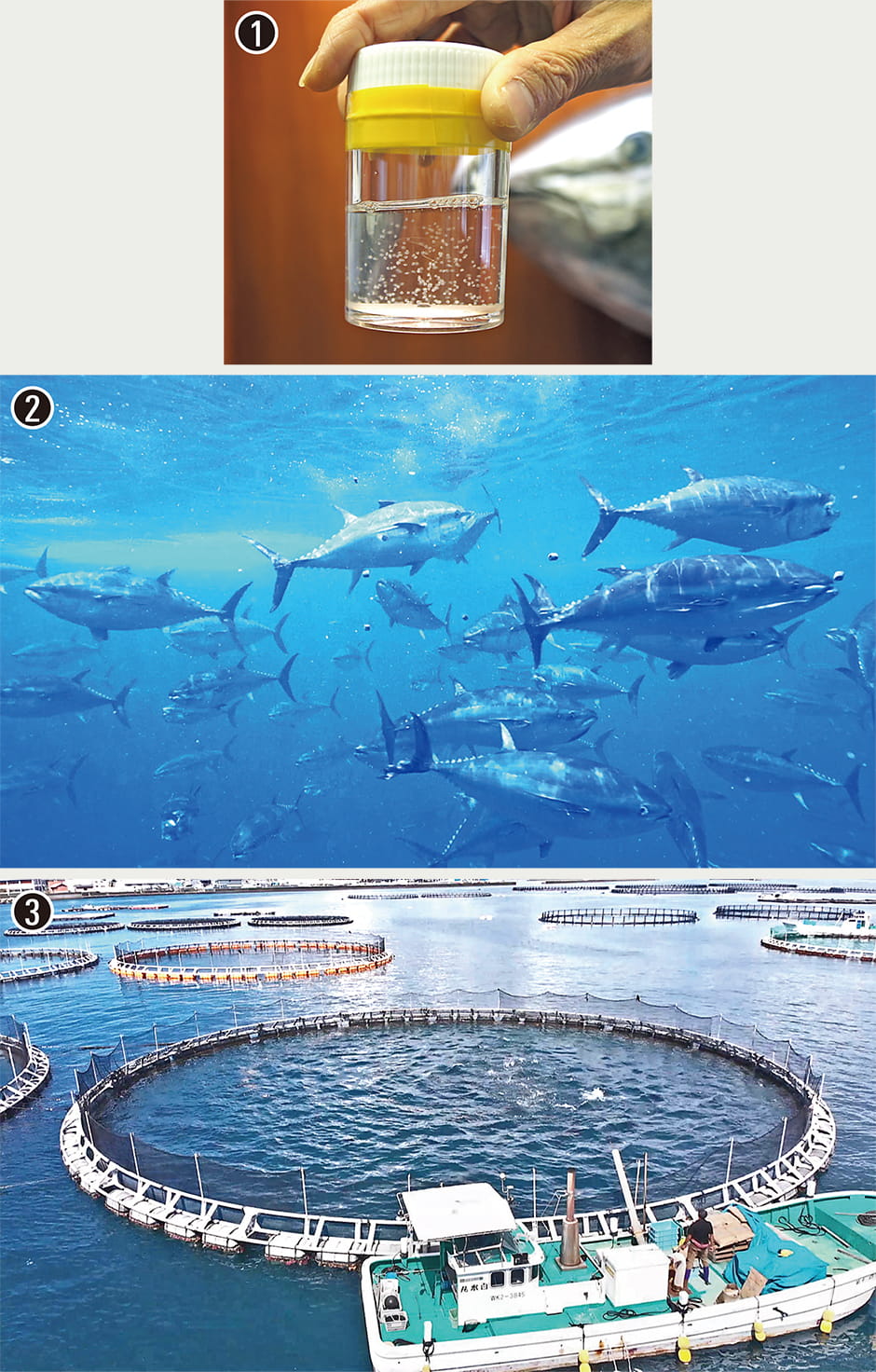
Figure 1. The world’s first successful full-cycle aquaculture of bluefin tuna❶ Bluefin tuna eggs. A female can release between several million and 50 million eggs in a single spawning event. In the open ocean, plankton can be scarce, and the larvae face a fierce struggle for survival as they grow to adulthood. ❷ Farmed bluefin tuna swimming calmly in a marine net cage. ❸ Marine net cages off Kii-Oshima Island, Wakayama Prefecture.
Full-cycle aquaculture of deep-sea blackthroat seaperch
In 2015, our institute began research on the full-cycle aquaculture of blackthroat seaperch, a deep-water fish that lives at depths of around 100 m. We initially tried to capture mature fish and rear them at the institute so that we could collect their eggs. However, bringing these fish to the surface caused decompression injuries, including bulging eyes and swollen abdomens, making them unsuitable for use as broodstock. We therefore decided to collect eggs directly from fish caught during the spawning season. Despite various difficulties, we eventually obtained eggs with the cooperation of the Joetsu Fisheries Cooperative in Niigata Prefecture.
The next challenge was rearing the fish from eggs. Around 25 days after hatching, the larvae would float to the surface, roll onto their sides, and swim in circles before dying. These symptoms led us to suspect viral nervous necrosis, but repeated tests detected no virus. Closer observation revealed excessive gas accumulation in their swim bladders. Fish rarely die from oxygen supersaturation, but are more susceptible to supersaturation with nitrogen and other gases. When we increased the oxygen concentration in the rearing water, survival improved dramatically. Previously, almost all the larvae had died, but this time 10,000 survived, rising to 30,000 the following year. These findings suggested that fish living exclusively in deep water have a more limited ability to regulate the gas in their swim bladders than species that move between shallow and deep water.
Our research on the full-cycle aquaculture of blackthroat seaperch faced another setback in 2024, when our facility in Toyama was severely damaged by the Noto Peninsula Earthquake (Figure 2). Fortunately, a small team was on duty over the New Year holiday, and many of the fish were saved. Nevertheless, we were forced to suspend our research. In October 2025, we used hormone treatment to induce spawning in the surviving three-year-old fish. We then collected and artificially fertilized their eggs and successfully reared the resulting larvae to the juvenile stage. In February 2026, we announced the world’s first successful full-cycle aquaculture of blackthroat seaperch. It became the 30th fish species for which our institute had achieved full-cycle aquaculture.
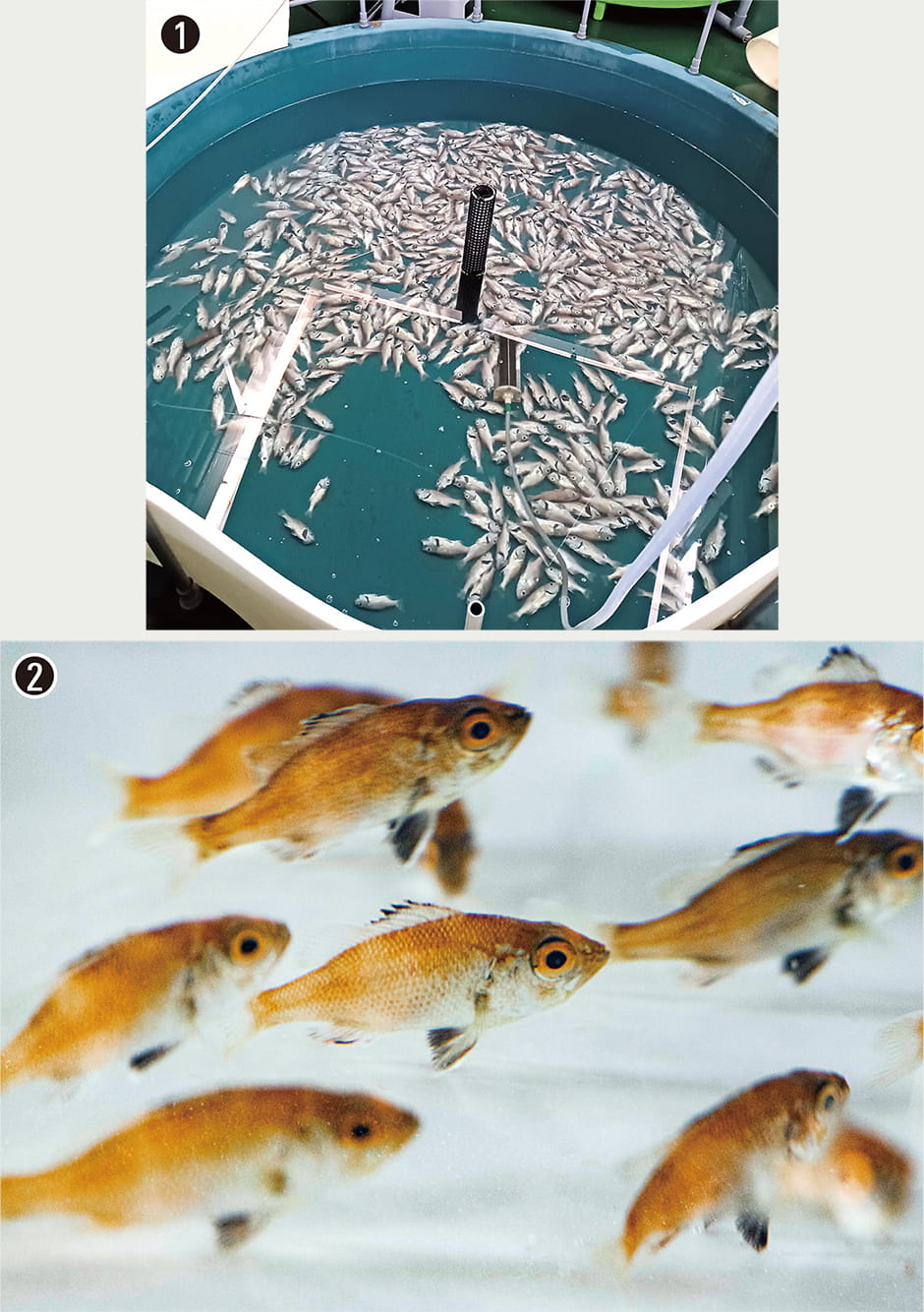
Figure 2. Full-cycle aquaculture of blackthroat seaperch❶ A tank in which all the blackthroat seaperch died as a result of the 2024 Noto Peninsula Earthquake, at the institute’s facility in Imizu City, Toyama Prefecture. ❷ Blackthroat seaperch juveniles produced through full-cycle aquaculture.
However, challenges remain with blackthroat seaperch. At least 90% of hatchery-reared fish are male. In humans, sex is typically determined by the sex chromosomes: males have XY chromosomes and females have XX chromosomes. In fish, however, the mechanisms of sex determination vary among species. Many fish species have the opposite pattern, with ZZ males and ZW females. In red sea bream, the gonads initially develop as ovaries. At around seven months of age, they begin to develop into testes in about half the fish, eventually producing a roughly equal ratio of females to males. I have studied red sea bream for many years, including work to decode their genome, but the mechanism behind this process remains unclear. In Japanese flounder, higher water temperatures can increase the proportion of males, while farmed eels are predominantly male under conventional rearing conditions. The precise mechanisms behind these patterns are not yet fully understood. Female eels are commercially desirable partly because they grow larger. Some eel farms therefore add soy isoflavones to the feed to encourage the development of females. These naturally occurring compounds in soybeans are used in eel feed as an alternative to hormone treatment.
So far, I have described how our research on rearing fish from eggs has led to the achievement of full-cycle aquaculture. But why is full-cycle aquaculture needed in the first place?
First, we need to prepare for a potential global shortage of protein. Increasing seafood production by catching more wild fish and shellfish could further deplete natural stocks. Climate change is also affecting catches, adding to concerns about future supplies. Aquaculture is therefore attracting attention as a way to meet growing demand. However, farming methods that depend on wild-caught juveniles still put pressure on natural stocks and do not fully address the problem of resource depletion.
When our institute first began research on red sea bream juvenile production, however, securing a stable supply of fish was a more immediate concern than conserving wild stocks. With hatchery-produced juveniles, the entire process can be managed from egg collection onward, allowing producers to plan when to harvest the fish. The greatest advantage, however, is the opportunity for selective breeding. Kindai University has maintained a selective breeding program for red sea bream since 1964, and our juveniles now grow twice as fast as their wild counterparts. By repeatedly selecting fast-growing fish as parents for the next generation, we have developed a strain that reaches a weight of 1 kg in about a year and a half, compared with at least three years for fish raised from wild juveniles.
Water quality has improved considerably with the use of formulated feeds
I also conduct research using genome editing. We have produced red sea bream in which the myostatin gene, which limits muscle growth, has been knocked out, increasing the edible portion of the fish. However, genome editing is not a solution to every problem. Knocking out a gene that suppresses appetite can accelerate growth in fish that have undergone little selective breeding. Yet editing the same gene in red sea bream that have been selectively bred over many generations has little additional effect, because selection has already favored fish that eat more and grow faster. Growth is also influenced by many genes, making it impractical to edit all of them. The key to further progress in aquaculture is to use genomic information to improve conventional selective breeding.
I must also address the environmental impact of aquaculture. Outside Japan, there is a widespread perception that aquaculture pollute the sea. In the United States, offshore aquaculture faces complex permitting requirements, alongside concerns about water pollution and the escape of farmed fish. Washington State, for example, has banned commercial finfish farming in net cages on state-owned aquatic lands managed by its Department of Natural Resources. Japan has continued to allow marine net cage aquaculture, which might lead some readers to assume that decades of fish farming have left its coastal waters heavily polluted. However, the environmental impact of aquaculture cannot be judged simply by how long it has been practiced.
Indeed, around 50–60 years ago, nutrient enrichment in coastal waters contributed to harmful algal blooms known as red tides, and mass deaths of farmed Japanese amberjack were reported in the news. At the time, farmers fed juvenile fish a mixture of minced sardines and formulated feed, which likely released substantial amounts of organic matter into the water. In the decades since farms shifted to formulated feeds alone, water quality has improved considerably.
The sea has a natural capacity to break down organic matter. Even when organic matter settles on the seabed, bacteria and other microorganisms in the water and sediments decompose it into inorganic nutrients. If the organic load exceeds this capacity, oxygen depletion can occur, and the resulting nutrient enrichment can contribute to red tides. Keeping that load within the sea’s capacity to process it can help limit pollution.
Declining nutrient levels, particularly nitrogen and phosphorus, may be one factor contributing to the recent decrease in coastal fishery catches. In the Seto Inland Sea, wastewater treatment has reduced nutrient inputs, contributing to poor coloration in farmed nori. Trials are therefore being conducted to adjust wastewater treatment in autumn and winter so that more nutrients reach the sea. This has even prompted debate over whether nutrient shortages could lead to declines in marine life.
Land-based aquaculture also presents environmental challenges. Recirculating systems require continuous water treatment, producing substantial amounts of organic sludge. Farming salmon and trout on land can also consume large amounts of electricity, particularly when the water needs to be cooled. To cover these costs, fish are often reared at high densities, which I believe can also affect their flavor. In terms of production costs, net cage aquaculture in Japan’s coastal waters can be considerably more economical than land-based systems.
Japan’s technology for producing juvenile marine fish from eggs is arguably the best in the world, and its diversity of farmed species is also unmatched. Readers in countries where a narrower range of fish is commonly eaten may find this diversity unfamiliar, but I encourage them to try sushi in Japan. With its fresh fish and wide variety of species, sushi offers a chance to discover delicious alternatives to rich, fatty fish such as tuna. By working in harmony with the marine environment, Japanese aquaculture brings fish from egg to table—a capability built on accumulated expertise.